All articles
Grammar Tips·July 25, 2026

Mastering the Spanish Se: Impersonal and Passive Voice Explained

Unlock the secrets of the Spanish 'se'. Learn the difference between impersonal and passive constructions to speak more naturally and accurately in any situation.
Mastering the Spanish Se: Impersonal and Passive Voice Explained

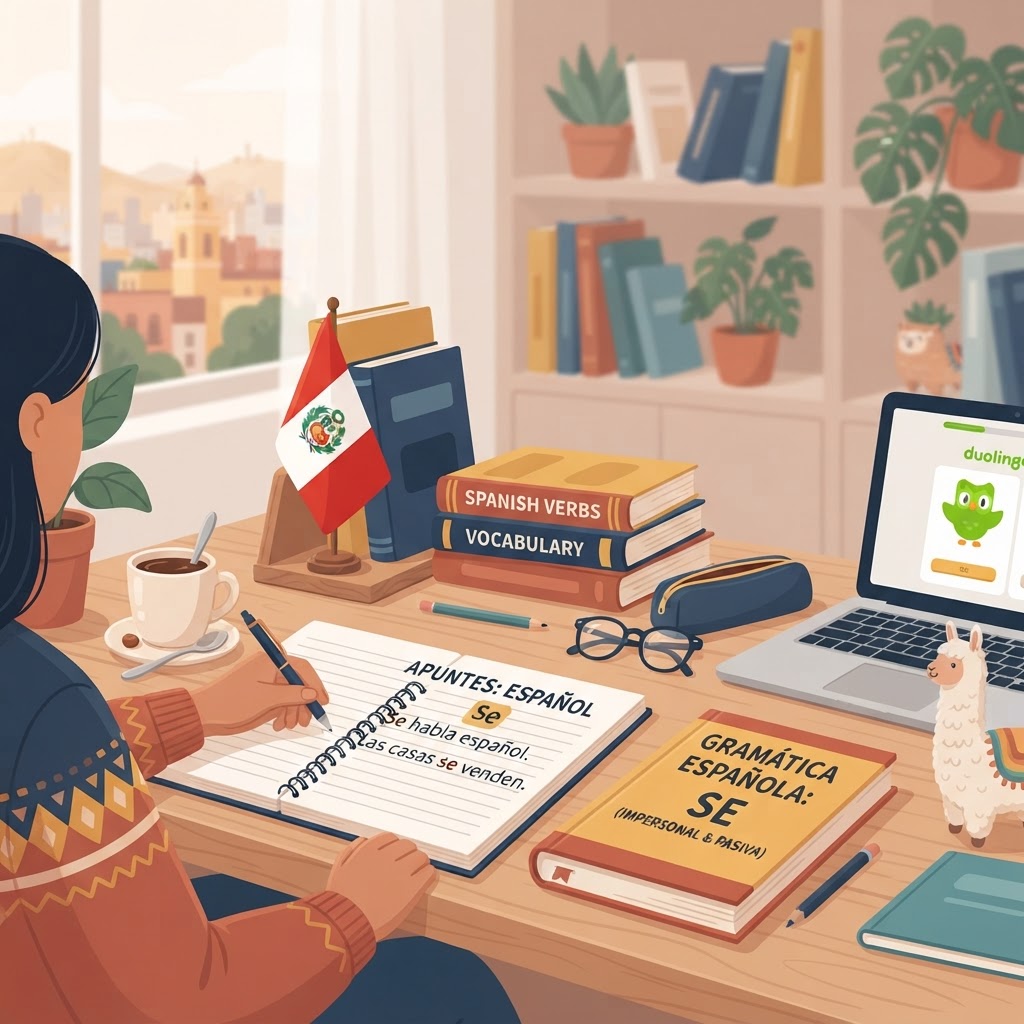
Mastering the Spanish 'Se': Impersonal and Passive Voice Explained. One of the most significant hurdles for intermediate Spanish learners is the word 'se'. It is a linguistic chameleon, changing its function based on the surrounding words and the speaker's intent. While you might first encounter 'se' as a reflexive pronoun (like in 'él se lava'), its most sophisticated uses appear in impersonal and passive constructions. At Speakup Academy, Carmen Solari often reminds students that mastering these forms is the key to transitioning from 'classroom Spanish' to the fluid, natural Spanish spoken on the streets of Lima or Madrid. Understanding how to use 'se' allows you to speak about general truths, rules, and events where the performer of the action isn't the main focus. ## The Impersonal 'Se': Speaking Generally. The impersonal 'se' is used when we want to talk about what 'people' do in general, or when the subject of the sentence is 'one,' 'everyone,' or 'someone.' It is the Spanish equivalent of saying 'One does not simply walk into Mordor' or 'They say it's going to rain.' The most important rule to remember here is that the verb is ALWAYS in the third-person singular. This is because there is no specific plural subject performing the action; the action is generalized. For example, if you are walking through the Miraflores district in Lima, you might say: 'Se come muy bien en este barrio' (One eats very well in this neighborhood). Note that 'come' is singular, even though many people are eating. This construction is perfect for giving directions, explaining customs, or stating general facts. In our live lessons at Speakup Academy, we practice this by describing cultural norms. Example 1: 'Se vive con mucha calma en el campo.' (One lives very calmly in the countryside.) Example 2: '¿Cómo se dice 'apple' en español?' (How does one say 'apple' in Spanish?) ## The Passive Reflexive: Focusing on the Object. The Passive Reflexive (Pasiva Refleja) looks very similar to the impersonal 'se', but it functions differently. We use this when the subject of the sentence is actually the thing being acted upon, rather than a person. Unlike the impersonal 'se', the verb in a passive reflexive sentence MUST agree in number with the noun it refers to. This is where many learners stumble. If the object is plural, the verb must be plural. If the object is singular, the verb remains singular. Think of it as a way to avoid saying 'is done' or 'are done' using the verb 'ser'. Example 3: 'Se vende esta casa.' (This house is for sale / This house is sold.) Example 4: 'Se venden estas casas.' (These houses are for sale / These houses are sold.) Notice how 'vende' becomes 'venden' because 'casas' is plural. This is a very common sight on signs throughout Latin America. If you're looking for work, you might see a sign that says 'Se buscan meseros' (Waiters are wanted/sought). Because 'meseros' is plural, the verb 'buscar' must be plural as well. ## Key Differences and Agreement Rules. Distinguishing between the two can be tricky, but there is a simple litmus test: can the verb be made plural? If the noun following the verb is the recipient of the action and can be pluralized, you are likely dealing with the Passive Reflexive, and your verb must agree. If you are talking about a general action or a state of being where there is no direct object, you are using the Impersonal 'Se', and the verb stays singular. Another nuance Carmen Solari highlights in our English-Spanish bridge sessions is the 'Personal A'. When the recipient of the action is a specific person, the passive reflexive can sometimes feel clunky or be confused with reflexive actions. In these cases, Spanish speakers often default to the impersonal 'se' with the personal 'a'. For example: 'Se busca a los culpables' (They are looking for the guilty ones). Here, 'se' remains impersonal and the verb stays singular because the 'a' marks the people as objects, not the grammatical subject. Example 5: 'Se prohíbe fumar en el edificio.' (Smoking is prohibited in the building.) In this case, 'fumar' acts as a singular noun, so the verb is singular. ## Practical Tips for Your Next Conversation. To start using these structures naturally, start by observing. Look at menus, street signs, and news headlines. You will see 'se' everywhere. When you are in a live lesson at Speakup Academy, try to describe your city using the impersonal 'se'. Instead of saying 'People in my city drink a lot of coffee,' try 'Se bebe mucho café en mi ciudad.' It sounds more sophisticated and native-like. Also, remember that these constructions are your best friend when you don't know who performed an action or when the perpetrator doesn't matter. If a glass broke, and you don't want to take the blame, you might use the accidental 'se' (a cousin of these forms): 'Se rompió el vaso.' But for general statements, stick to the agreement rules: singular for general ideas, and matched agreement for objects. ## Conclusion: Key Takeaways. Mastering the impersonal and passive 'se' is a journey of practice and observation. 1. Use the Impersonal 'Se' for general 'one/they' statements, always using the third-person singular. 2. Use the Passive Reflexive to focus on the object, ensuring the verb agrees with that object (singular or plural). 3. Avoid using a specific subject (yo, tú, nosotros) when using these forms. 4. Look for agreement clues: if the noun is plural, the verb usually needs to be plural too (unless the personal 'a' is present). Consistent practice in a conversational setting is the best way to make these rules second nature. Whether you are self-studying or joining us for a session, keep pushing the boundaries of your grammar—your fluency will thank you!