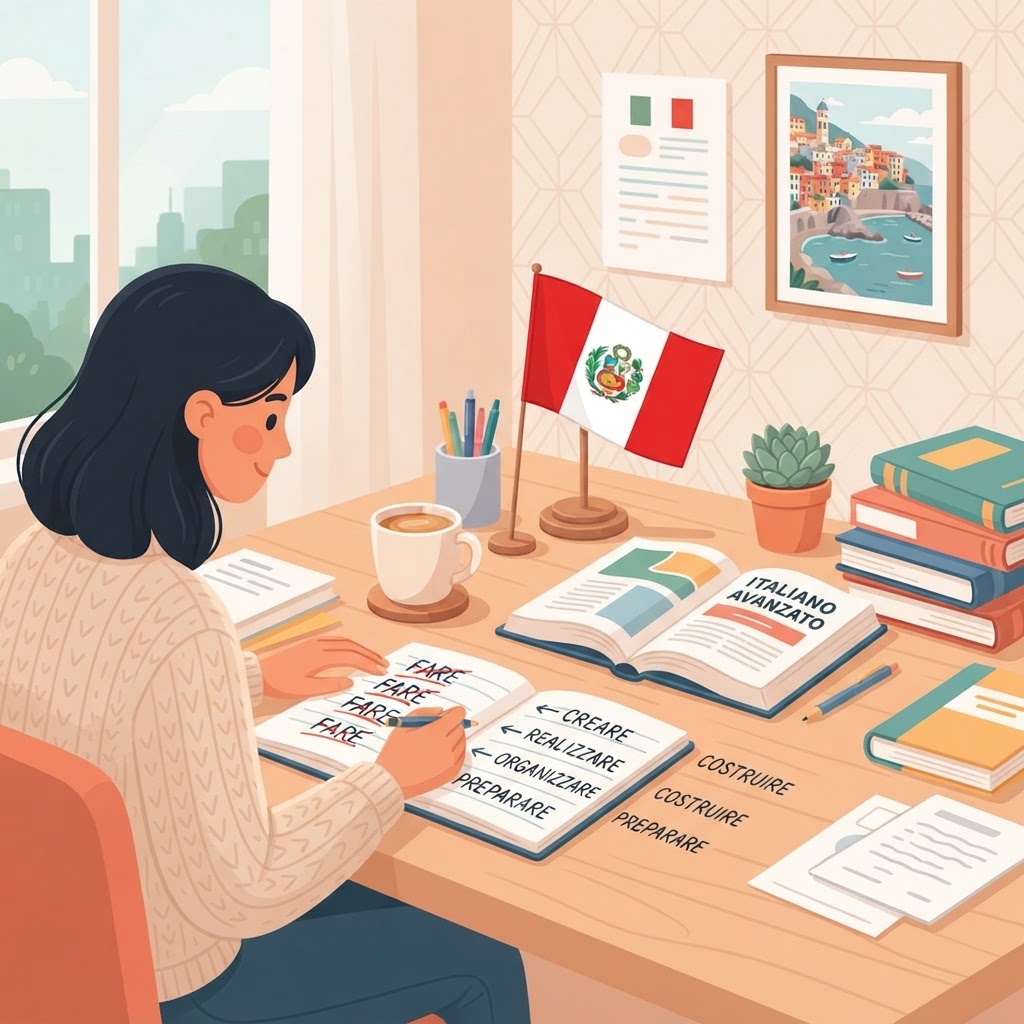
Italian Fluency Secrets: Moving Beyond the Overused Verb 'Fare'
If you have been studying Italian for any length of time, you have undoubtedly met the "Swiss Army Knife" of the language: the verb fare. From the Latin facere, it translates broadly to "to do" or "to make." It is the first verb we reach for when we want to say we are making dinner, taking a photo, or doing our homework. For a beginner, fare is a lifesaver. It bridges gaps and allows you to communicate basic needs with minimal effort. However, as you transition into an intermediate or advanced learner, relying too heavily on fare becomes a "vocabulary crutch" that can make your speech sound repetitive and overly simplified.
In the live lessons at Speakup Academy, our founder Carmen Solari often reminds students that Italian is a language of immense color and texture. Native speakers rarely use generic terms when a precise, descriptive verb is available. By swapping out fare for more specific alternatives, you don't just sound more fluent—you demonstrate a deeper understanding of the Italian cultural emphasis on precision and artistry. Today, we are going to look at how to replace this "junk verb" with high-impact vocabulary that will transform your Italian overnight.
The Problem with 'Fare' Addiction
The issue isn't that fare is wrong; it is that it is often lazy. Imagine a chef who uses the same knife for every task—slicing bread, deboning fish, and peeling grapes. While the job might get done, the results lack the finesse of a professional. In Italian, using fare for everything from birthdays to business deals tells the listener that you are translating from your native language rather than thinking in Italian.
To move beyond the B1 level plateau, you must begin to see verbs not just as actions, but as tools for description. When you use a specific verb, you provide more context. You move from simply "doing" to "executing," "performing," or "crafting."
Culinary Precision: Beyond 'Fare la Cena'
In Italy, the kitchen is a sacred space, and the language reflects this. While you can say fare la cena (to make dinner), it sounds quite generic. Depending on what you are actually doing, there are far better options that show off your vocabulary.
- Impastare: If you are making pasta or bread, you aren't just "making" it; you are impastando (kneading).
- Soffriggere: When you start a sauce with onions and garlic, you are soffriggendo (sautéing/lightly frying).
- Infornare: Instead of "putting it in the oven," use infornare.
Example 1: Original: Devo fare una torta per la festa. (I have to make a cake for the party.) Elevated: Devo pasticciare un po' in cucina per preparare una torta. (I need to mess around/get creative in the kitchen to prepare a cake.) Or more simply: Cucinare or Infornare.
Professional and Academic Polish
If you are using Italian for work or study, precision is even more critical. Using fare in a professional email can make you sound less authoritative. Instead, look for verbs that describe the nature of the task.
- Svolgere: This is the perfect replacement for "doing" a task or an activity. It implies a process or a development.
- Redigere: Use this instead of fare when talking about writing a document, a report, or a contract. It means "to draft" or "to draw up."
- Attuare: When you are "making" a plan happen, you are attuando (implementing/carrying out) those plans.
Example 2: Original: Abbiamo fatto un nuovo piano di marketing. (We made a new marketing plan.) Elevated: Abbiamo elaborato un nuovo piano di marketing. (We have developed/elaborated a new marketing plan.)
Essential Collocations You Need to Know
There are certain expressions where native speakers almost never use fare, even though the English equivalent suggests "to do" or "to make." These are called collocations—words that naturally go together. Learning these is the fastest way to improve your natural phrasing.
1. Photography: Scattare una foto
While fare una foto is common in casual speech, scattare (to snap or trigger) is the technically correct and more elegant verb. It evokes the actual action of the camera shutter.
2. Birthdays: Compiere gli anni
In English, we "have" a birthday or "turn" an age. In Italian, beginners often say faccio 30 anni. However, the more sophisticated way to express this is using the verb compiere (to fulfill/complete). Example: Domani compio trent'anni. (Tomorrow I turn thirty.)
3. Agreements: Stringere un accordo
Instead of "making" a deal or an agreement (fare un accordo), Italians stringono (to tighten/squeeze) an agreement. It implies the handshake that seals the deal. Example: Le due aziende hanno stretto un accordo importante. (The two companies struck an important deal.)
The Speakup Academy Approach: Contextual Learning
At Speakup Academy, our live Italian lessons with Carmen Solari focus on these nuances from day one. We believe that learning vocabulary in isolation is a mistake. Instead, we practice these specific verbs in real-world simulations. Whether you are role-playing a business meeting or a casual dinner in Trastevere, our goal is to help you shed the "translation layer" of your brain.
We encourage our students to keep a "Fare Replacement" journal. Every time you find yourself writing or saying fare, stop and ask: "Is there a more specific verb for this action?" Usually, the answer is yes, and finding it is where the real learning happens.
Key Takeaways
- Be Specific: If the action involves cooking, use culinary verbs (affettare, sminuzzare, infornare).
- Be Professional: In the office, swap fare for svolgere, redigere, or elaborare.
- Learn Collocations: Memorize specific pairings like scattare una foto and compiere gli anni to sound more like a local.
- Slow Down: Take a second before speaking to choose a descriptive verb rather than the easiest one.
Mastering these subtle shifts in vocabulary will signal to native speakers that you aren't just someone who knows some Italian, but someone who respects and understands the nuances of the language. Keep practicing, stay curious, and don't be afraid to leave the "safety" of fare behind!
Interested in taking your Italian to the next level? Join Carmen Solari and our global community of learners for live, interactive sessions at Speakup Academy today.