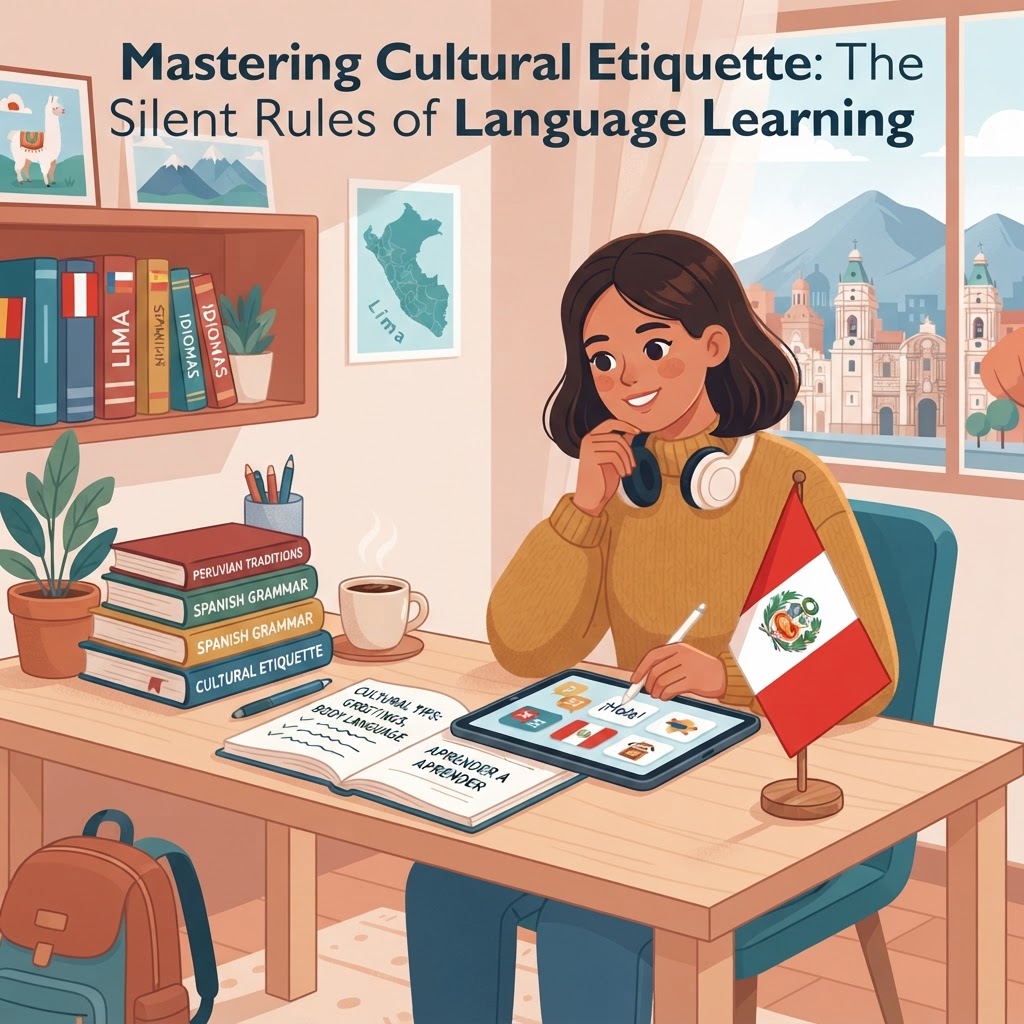
The Invisible Bridge Between Grammar and Connection
When we start learning a new language, we often focus on the building blocks: vocabulary, verb conjugations, and syntax. We spend hours drilling irregular verbs or perfecting our pronunciation. However, there is a hidden layer of fluency that textbooks rarely cover—the 'politeness gap.' This is the space where cultural etiquette dictates how we use the language we’ve learned.
At Speakup Academy, we believe that true fluency is not just about what you say, but how you make the other person feel. Whether you are in a live Spanish lesson with Carmen Solari or practicing your Italian with a peer, understanding the social contract of your target language is essential. Language is a social tool, and every culture has its own set of 'silent rules' regarding directness, formality, and social distance. Failing to grasp these can lead to awkward misunderstandings, even if your grammar is technically perfect.
The Directness Spectrum: Why 'Please' Isn't Always Enough
One of the most significant cultural hurdles for English speakers learning Romance languages (and vice-versa) is the concept of directness. In the English-speaking world, particularly in the UK and North America, politeness is often achieved through 'softening' language. We use modals like 'could,' 'would,' and 'might,' and we often frame requests as questions. For example, instead of saying 'Give me the salt,' an English speaker will say, 'I was wondering if you could possibly pass the salt?'
In Spanish and Italian, however, the directness spectrum works differently. In a casual setting, using too many softening layers can actually make you sound distant, sarcastic, or insecure. A direct imperative—"¿Me das la sal?" (Give me the salt?)—is perfectly polite among friends and family because the intimacy of the relationship provides the 'politeness' that English speakers usually encode in the grammar.
- English Example: "I was wondering if I could have a coffee, please?" (Highly indirect/polite).
- Spanish Example: "¿Me pones un café?" (Literal: Do you put a coffee for me? — Direct and standard in a café).
- Italian Example: "Mi dai una mano?" (Literal: Give me a hand? — Direct request for help).
If you use the English logic of indirectness in a Spanish tapas bar, you might be met with a confused look. If you use the Spanish logic of directness in a London pub, you might be perceived as demanding. Mastering this shift is a core part of the immersive experience we provide at Speakup Academy.
The Power of Hierarchy: Navigating the 'T-V' Distinction
For English speakers, the concept of having two different versions of 'you' can be intimidating. This is known as the T-V distinction (from the Latin tu and vos). In Spanish, you have tú and usted; in Italian, tu and Lei. While English lost its formal 'you' (thou vs. you) centuries ago, the distinction remains a vital social regulator in Europe and Latin America.
In her live lessons, Carmen Solari often emphasizes that choosing the right 'you' is about more than just age; it’s about social hierarchy and professional distance. In Lima, Peru, for instance, usted is frequently used as a sign of respect for elders and strangers, even in relatively casual settings. In contrast, in modern Spain, tú has become much more common, even between students and teachers.
In Italian, the use of Lei (formal you) is strictly adhered to in professional environments. Addressing a potential employer or a government official as tu isn't just a grammar error; it’s a breach of etiquette that can close doors. Understanding when to 'break the ice' and switch to the informal is a delicate dance. Usually, the person of higher status or age will initiate the transition with a phrase like "Diamoci del tu" (Let's use 'tu') in Italian.
The 'Sorry' Paradox: Apology Culture and Social Lubrication
Apologies are another area where cultural norms diverge sharply. In English, particularly British English, 'sorry' is a social lubricant. We say it when someone bumps into us, when we want to ask a question, or when we simply exist in someone else's space.
In Spanish and Italian culture, apologies are generally reserved for actual transgressions. If you use the Spanish perdón or disculpe with the same frequency that an English speaker uses 'sorry,' you may come across as overly submissive or even insincere.
- General Tip: Instead of apologizing for needing to pass someone in a narrow hallway, a Spanish speaker might simply say "Permiso" (Permission), and an Italian might say "Permesso." These aren't apologies; they are functional announcements of intent.
Learning these nuances allows you to move through a foreign city with the confidence of a local. It reduces the 'friction' of daily interactions and helps you build rapport more quickly.
The Art of the Interruption: Turn-Taking and Silence
Finally, we must consider the rhythm of conversation. Linguistic studies show that different cultures have different tolerances for silence and overlapping speech. In many English-speaking cultures, interrupting is considered rude. We wait for a clear pause before we begin speaking.
In many Mediterranean and Latin American cultures, however, overlapping speech—where two people talk at the same time—is often a sign of active listening and high engagement. If you wait for a long pause in a group of Italians or Spaniards, you might never get a word in! At Speakup Academy, we encourage students to embrace this 'collaborative overlap.' It’s not about being loud; it’s about showing the speaker that you are right there with them, following every word.
Key Takeaways for the Culturally Savvy Learner
To truly master a language, you must become a student of the culture that breathes life into it. Here are the core principles to keep in mind:
- Observe the Directness: Watch how native speakers make requests. Do they use 'softeners' or direct imperatives?
- Respect the 'Usted/Lei': When in doubt, start formal. It is always easier to move from formal to informal than to recover from an accidental insult.
- Function over Apology: Use functional phrases like "Permiso" instead of constant apologies for minor social navigations.
- Listen to the Rhythm: Pay attention to how long native speakers wait before responding. Adjust your own timing to match the cultural heartbeat.
By focusing on these cultural nuances, you transform your language skills from a dry academic exercise into a powerful tool for human connection. Ready to dive deeper? Join one of our live sessions at Speakup Academy and start practicing these 'silent rules' in a supportive, real-world environment.