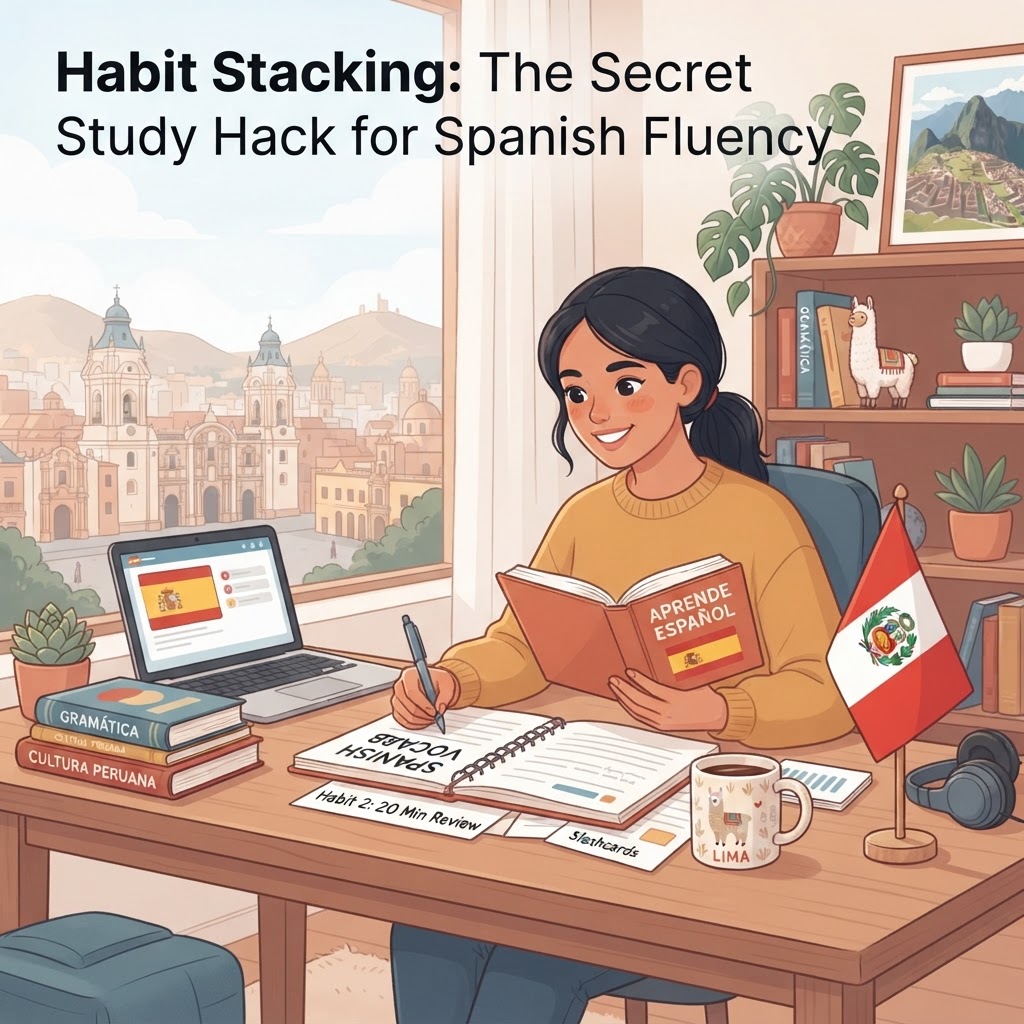
The Myth of the Two-Hour Study Block
For many adult learners, the biggest hurdle to mastering Spanish isn't the complexity of the subjunctive mood or the speed of native speakers in Lima. It is time. We often fall into the trap of believing that unless we have a clear, uninterrupted two-hour window to sit with a textbook, we aren't 'really' studying. This mindset leads to a cycle of 'all or nothing' learning: intense bursts of energy followed by weeks of inactivity.
At Speakup Academy, Carmen Solari often reminds her students that language acquisition is less like a marathon and more like a series of small, daily sprints. The secret to bridging the gap between your live lessons isn't finding more time—it is reclaiming the time you already have. Enter 'Habit Stacking,' a powerful psychological hack that can transform your daily routine into a comprehensive Spanish immersion environment.
What is Habit Stacking?
Habit stacking is a concept popularized by behavioral scientists that involves 'stacking' a new habit you want to build onto an existing habit you already do without thinking. The formula is simple: 'After [Current Habit], I will [New Language Habit].'
By anchoring a new Spanish micro-task to an established behavior like brushing your teeth, making coffee, or checking your mail, you bypass the need for intense willpower. Your existing habit acts as a trigger for the new one. Over time, these small actions compound, leading to significant gains in vocabulary, listening comprehension, and speaking confidence.
Stack 1: The Morning 'Cafecito' Conjugation
Most of us have a morning ritual involving caffeine. Instead of scrolling through social media while your coffee brews, use those three to five minutes for a focused verb drill. This is a perfect time to practice the 'verb of the day.'
The Stack: After I turn on the coffee maker, I will conjugate one irregular Spanish verb in the present tense out loud.
Example: Current Habit: Brewing coffee. Spanish Action: Conjugating the verb Tener (To have). Practice: 'Yo tengo, tú tienes, él tiene, nosotros tenemos, vosotros tenéis, ellos tienen.'
By the time your coffee is ready, you have reinforced a vital grammatical structure. This micro-win sets a positive tone for the rest of your day and ensures that Spanish is the first thing on your mind.
Stack 2: The 'Commute Commentary' Hack
If you drive, walk, or take public transit to work, you are sitting on a goldmine of 'dead time.' The 'Commute Commentary' hack involves narrating your surroundings or your plans for the day in Spanish. This forces your brain to retrieve vocabulary under pressure, similar to how you would during a live conversation with Carmen.
The Stack: After I lock my front door, I will describe three things I see or three things I will do today in Spanish.
Examples:
- 'Hoy tengo una reunión importante a las diez.' (Today I have an important meeting at ten.)
- 'El cielo está un poco nublado esta mañana.' (The sky is a bit cloudy this morning.)
- 'Necesito comprar pan después del trabajo.' (I need to buy bread after work.)
This habit builds the mental muscle required for spontaneous speech, moving you away from translating in your head and toward thinking directly in the target language.
Stack 3: The 'Kitchen Labeling' Anchor
One of the most effective ways to build vocabulary is through visual triggers. Habit stacking can be applied to household chores to reinforce nouns and verbs related to the home. Every time you perform a recurring task, such as loading the dishwasher or clearing the table, name the objects you touch.
The Stack: After I finish eating dinner, I will name five items I am putting away in Spanish.
Example:
- 'El plato' (The plate)
- 'El tenedor' (The fork)
- 'La servilleta' (The napkin)
- 'El vaso de agua' (The glass of water)
- 'La mesa' (The table)
This contextual learning is far more effective than rote memorization from a list because your brain associates the Spanish word with a physical object and a specific action.
Preparing for Your Speakup Academy Lessons
While micro-habits are essential for daily maintenance, they work best when integrated with professional guidance. At Speakup Academy, our live sessions are designed to take the fragments of Spanish you’ve practiced throughout the week and weave them into fluent conversation.
Carmen Solari’s methodology emphasizes 'Living the Language.' When you arrive at your session having already practiced your 'Morning Cafecito' or 'Commute Commentary,' you aren't starting from zero. You are 'warmed up.' You can use your live time to ask specific questions about the nuances you discovered during your daily stacks, such as: 'Carmen, when I was describing my commute, should I use "por" or "para" when talking about the route?'
The Psychology of 'Just One Minute'
The beauty of habit stacking for Spanish learners is that it lowers the barrier to entry. On days when you are exhausted and the thought of a full study session is daunting, you can still manage to name three items in your kitchen. This keeps the 'neural pathways' active. Consistent, low-intensity contact with Spanish is significantly more effective for long-term retention than infrequent, high-intensity cramming.
Key Takeaways
- Identify Your Anchors: Look for existing habits like drinking water, checking the time, or opening your laptop.
- Keep it Micro: Your Spanish stack should take no more than 1-2 minutes to complete.
- Speak Out Loud: Vocalizing the words engages your motor memory and improves pronunciation.
- Bridge the Gap: Use these hacks to prepare for your live Speakup Academy lessons, ensuring you are always ready to converse.
- Be Consistent: The goal is to make Spanish as automatic as your morning cup of coffee.
Start small today. What is the one habit you can stack right now? Whether it is a quick conjugation or a simple sentence about your environment, every word brings you closer to the fluency you’re working so hard to achieve. ¡Vamos!