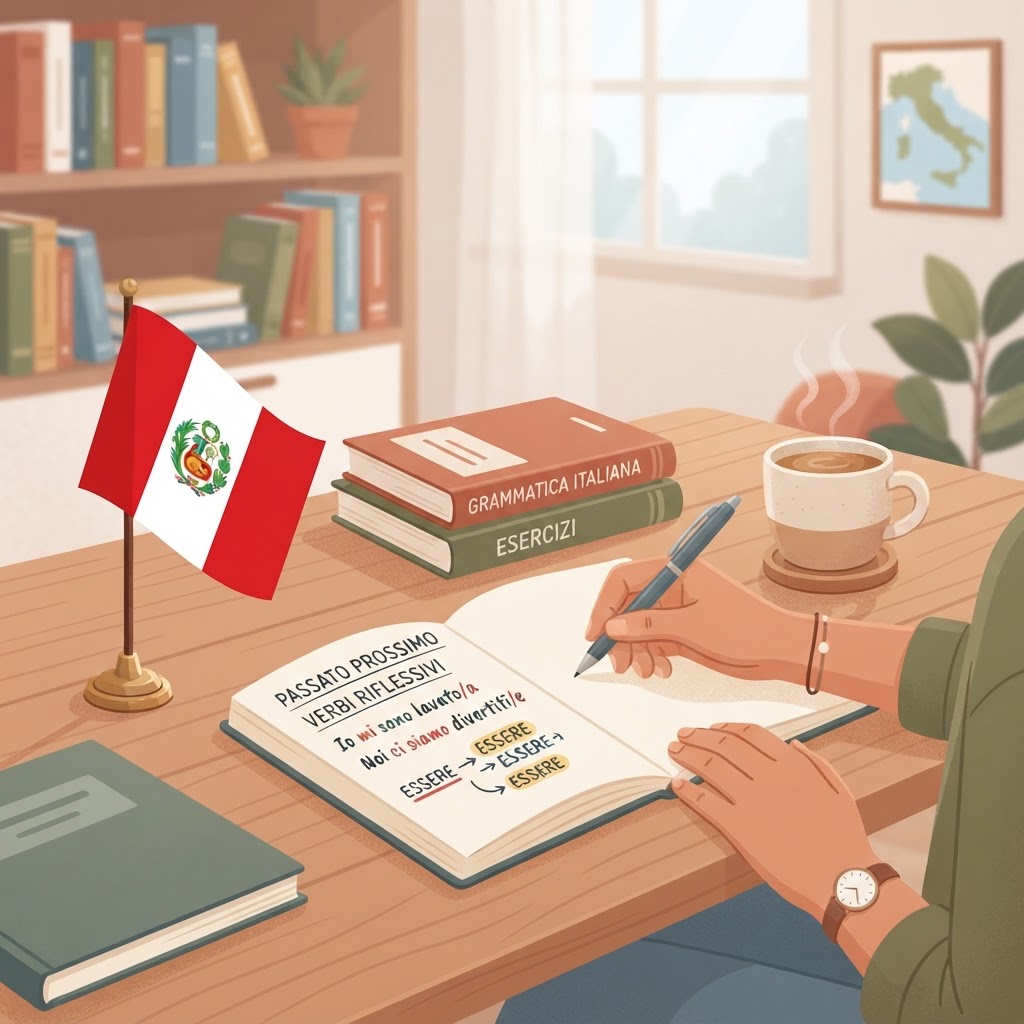
If you have ever introduced yourself in Italian, you have already used a reflexive verb. Mi chiamo... (I call myself...) is often the very first sentence a student learns. However, as you progress from basic introductions to storytelling, a common hurdle appears: the past tense.
In Italian, the passato prossimo (present perfect) is the workhorse of conversation. While most verbs use avere (to have) as an auxiliary, reflexive verbs follow a different set of rules that can feel counterintuitive to English speakers. Today, we are diving deep into the mechanics of reflexive verbs in the past tense to help you move beyond the basics and speak with the confidence of a native.
The Golden Rule: Always Use Essere
In English, we say "I washed myself" or "I woke up." In Italian, when an action is reflexive—meaning the subject performs the action on themselves—the auxiliary verb in the past tense is always essere (to be).
This is a non-negotiable rule. Even if the non-reflexive version of the verb uses avere, the moment it becomes reflexive, it switches to essere. For example, the verb lavare (to wash) usually takes avere: Ho lavato la macchina (I washed the car). But if you are washing yourself, it becomes mi sono lavato.
At Speakup Academy, Carmen Solari often reminds students that this switch to essere is actually a helpful signal. It tells the listener immediately that the action is staying with the subject. When you practice this in our live lessons, you’ll start to feel the rhythm of the mi sono, ti sei, si è patterns until they become second nature.
The Agreement Dance: Matching Gender and Number
Because reflexive verbs use essere in the past tense, they trigger a specific grammatical requirement: the past participle must agree in gender and number with the subject. This is where many intermediate learners trip up.
If the subject is a man, the participle ends in -o. If it is a woman, it ends in -a. For groups, you will use -i (masculine or mixed) or -e (feminine).
Let’s look at the verb svegliarsi (to wake up):
- Marco: Mi sono svegliato alle otto. (I woke up at eight.)
- Giulia: Mi sono svegliata alle otto. (I woke up at eight.)
- Marco e Giulia: Ci siamo svegliati tardi. (We woke up late.)
- Giulia e Maria: Ci siamo svegliate presto. (We woke up early.)
This agreement is vital for clarity. It provides extra information about who is speaking or being spoken about, which is one of the beautiful, descriptive layers of the Italian language.
Common Reflexive Verbs in Daily Life
To master these, you need to see them in context. Here are four concrete examples of reflexive verbs used in the past tense that you will likely use in every conversation:
- Divertirsi (to have fun): Ieri sera ci siamo divertiti molto alla festa. (Last night we had a lot of fun at the party.)
- Arrabbiarsi (to get angry): Perché ti sei arrabbiata con lui? (Why did you [feminine] get angry with him?)
- Vestirsi (to get dressed): Si sono vestiti in fretta per non fare tardi. (They got dressed quickly so as not to be late.)
- Mettersi (to put on/wear): Mi sono messo la giacca perché faceva freddo. (I put on my jacket because it was cold.)
Notice in the last example (mi sono messo la giacca) that even though there is a direct object (la giacca), the verb remains reflexive because the action of "putting on" is done to oneself.
Reciprocal Verbs: When "We" Becomes Reflexive
Italian also uses reflexive structures for "reciprocal" actions—things people do to each other. Verbs like vedersi (to see each other), incontrarsi (to meet each other), or innamorarsi (to fall in love) follow the exact same past tense rules.
- I miei nonni si sono conosciuti nel 1960. (My grandparents met each other in 1960.)
- Vi siete visti ieri in centro? (Did you [plural] see each other yesterday downtown?)
Understanding that reciprocal actions are grammatically identical to reflexive ones simplifies your learning process. You aren't learning a new rule; you are just applying the essere + agreement rule to a shared action.
Practical Tips for Mastery
If this feels like a lot to juggle—the pronoun, the auxiliary, and the ending—don't worry. Even advanced learners occasionally miss an agreement. The key is to practice in "chunks." Instead of thinking of four separate words, try to memorize the block: Mi-sono-andato or Ci-siamo-divertiti.
In our sessions at Speakup Academy, we focus on these high-frequency chunks. Carmen’s approach emphasizes using these verbs in real stories about your weekend or your morning routine. When you attach the grammar to a real memory, your brain stores it much more effectively than a conjugation table ever could.
Key Takeaways
To wrap up, remember these three pillars of reflexive verbs in the past:
- The Auxiliary: Always use essere, never avere.
- The Pronoun: Don't forget the reflexive pronoun (mi, ti, si, ci, vi, si) before the auxiliary.
- The Agreement: Change the ending of the past participle to match the gender and number of the subject.
Mastering this specific corner of Italian grammar will instantly make your Italian sound more polished and precise. Keep practicing, and don't be afraid to make mistakes—every mi sono sbagliato (I was mistaken) is just another step toward fluency!