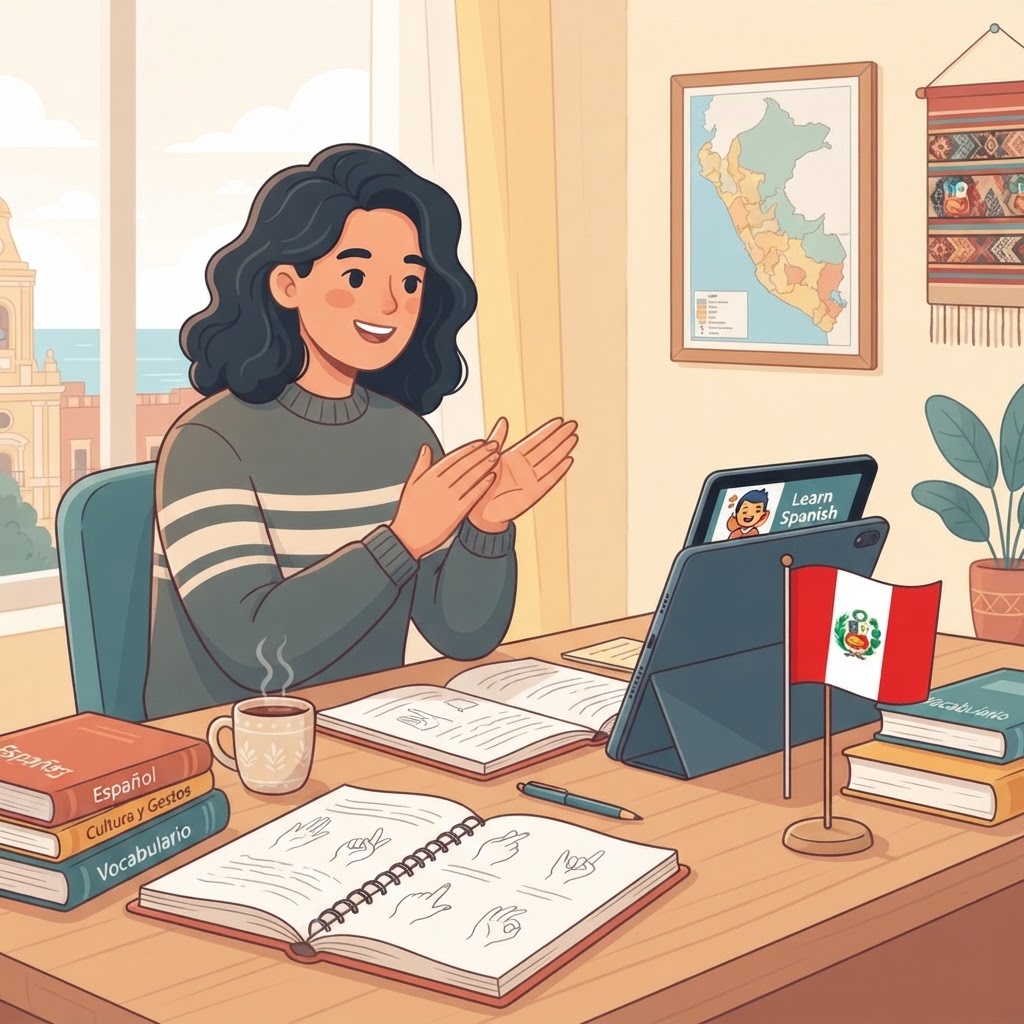
Beyond Words: Mastering the Silent Language of Spanish Gestures
Imagine you are sitting in a bustling café in the heart of Lima, Peru, or perhaps a sun-drenched plaza in Madrid. You are following the conversation well enough, but suddenly, your friend pulls down their lower eyelid with one finger without saying a word. Or maybe they tap their elbow while discussing a mutual acquaintance. If you are only studying from a textbook, these moments can feel like a secret code you haven't been given the key to.
At Speakup Academy, we believe that true fluency goes far beyond verb conjugations and vocabulary lists. As Carmen Solari often emphasizes in our live lessons, Spanish is a high-context language. This means that a significant portion of the meaning is carried not just by what we say, but by how we move, how close we stand, and the specific hand signals we use to punctuate our thoughts. Mastering these non-verbal cues is the 'secret sauce' that transforms a student into a confident communicator.
Why Gestures are the Soul of Spanish Communication
In many Spanish-speaking cultures, communication is an exuberant, full-body experience. Gestures aren't just 'extra'—they are essential tools for emphasis, emotion, and clarity. For adult learners, adopting these gestures can actually help bridge the gap when your vocabulary fails you. It allows you to convey complex ideas or warnings with a single movement, buying you time to think of the right words while still staying engaged in the flow of conversation.
Furthermore, using the correct body language signals to native speakers that you respect and understand the cultural nuances of the language. It breaks down barriers and makes interactions feel more 'warm' (caluroso), which is a cornerstone of social life in both Spain and Latin America.
5 Essential Spanish Gestures You Need to Know
To help you navigate your next conversation, let's break down five of the most common gestures you will encounter across the Spanish-speaking world.
1. ¡Ojo! (Watch Out / Be Careful)
The Gesture: Use your index finger to pull down the skin just below your lower eyelid. The Meaning: This is a warning. It literally means 'eye,' but it translates to 'Watch out,' 'Pay attention,' or 'I’m keeping an eye on you.' Example: '¡Ojo! El piso está muy resbaloso.' (Watch out! The floor is very slippery.)
2. Mucha Gente (A Crowd)
The Gesture: Hold your hand up with your palm facing you, fingers spread, and then quickly open and close your fingers into a bunch (like a claw). The Meaning: This indicates that a place is packed or crowded. It is much faster than saying 'está muy lleno.' Example: 'No entramos al concierto porque había mucha gente.' (We didn't go into the concert because it was very crowded.)
3. ¿Tienes pasta? / ¿Tienes plata? (Money)
The Gesture: Rub your thumb against your index and middle fingers, as if feeling the texture of a coin or a bill. The Meaning: This refers to money. In Spain, you might hear 'pasta,' while in Peru and much of Latin America, Carmen’s students will hear 'plata.' Example: 'Ese coche es muy caro, ¿tienes plata?' (That car is very expensive, do you have the money?)
4. Pointing with the Lips
The Gesture: Instead of using a finger, you pucker your lips and slightly tilt your head in a specific direction. The Meaning: This is a very common way to point to something or someone nearby without being overly 'pointed' or rude with a finger. It is especially prevalent in Latin American countries. Example: '¿Dónde están mis llaves?' (Where are my keys?) — [Friend points with lips toward the table].
5. Está para chuparse los dedos (Delicious)
The Gesture: Bring your fingertips together, kiss them, and then flourish your hand outward, or mimic the action of licking a finger. The Meaning: This signifies that the food is exceptionally good—literally 'finger-licking good.' Example: '¡Este ceviche está para chuparse los dedos!' (This ceviche is delicious!)
Navigating Personal Space and Physical Contact
One of the biggest adjustments for learners from North America or Northern Europe is the concept of 'proxemics'—the distance we keep between ourselves and others. In Spanish-speaking cultures, personal space is generally smaller. It is common to stand close enough to feel the other person's warmth, and light touches on the arm or shoulder during a conversation are signs of engagement and friendliness, not intrusion.
Greetings also follow this 'close-contact' rule. In Spain, the 'dos besos' (two kisses on the cheeks) is standard, while in many Latin American countries like Peru, a single 'besito' is the norm for social greetings between women or between men and women. Understanding these subtle shifts in physical etiquette prevents awkward 'dodging' moments and helps you feel more at home in social settings.
How to Practice Non-Verbal Cues in Live Lessons
You might feel a bit shy about using these gestures at first, and that is perfectly normal! The best way to integrate them is through observation and low-stakes practice. During our live sessions at Speakup Academy, we encourage students to use their cameras and mirror the gestures Carmen uses.
Try this: the next time you want to say something is crowded in class, don't just say the words—use the 'mucha gente' hand sign. When you are warned about a tricky grammar point, respond with the '¡ojo!' gesture. By physically performing the language, you create stronger neural pathways, making the vocabulary easier to recall later.
Key Takeaways
- Spanish is physical: Communication involves the whole body, not just the voice.
- Context is king: Gestures like '¡Ojo!' or pointing with the lips provide instant clarity in busy environments.
- Regionalisms matter: Be aware of local terms for money (pasta vs. plata) and greeting customs (one kiss vs. two).
- Practice makes natural: Don't be afraid to 'over-act' a little in your practice sessions to build muscle memory.
Learning a language is about building bridges to other people. By mastering the silent language of gestures, you aren't just speaking Spanish—you are living it. Ready to put these tips into practice? Join us in our next live session and let's get talking (and gesturing) together!