All articles
Study Hacks·August 13, 2026

Stop Forgetting Italian: 4 Active Recall Hacks for Fluency

Tired of forgetting Italian vocabulary as soon as you close your book? Discover how active recall can double your retention and make your study sessions stick.
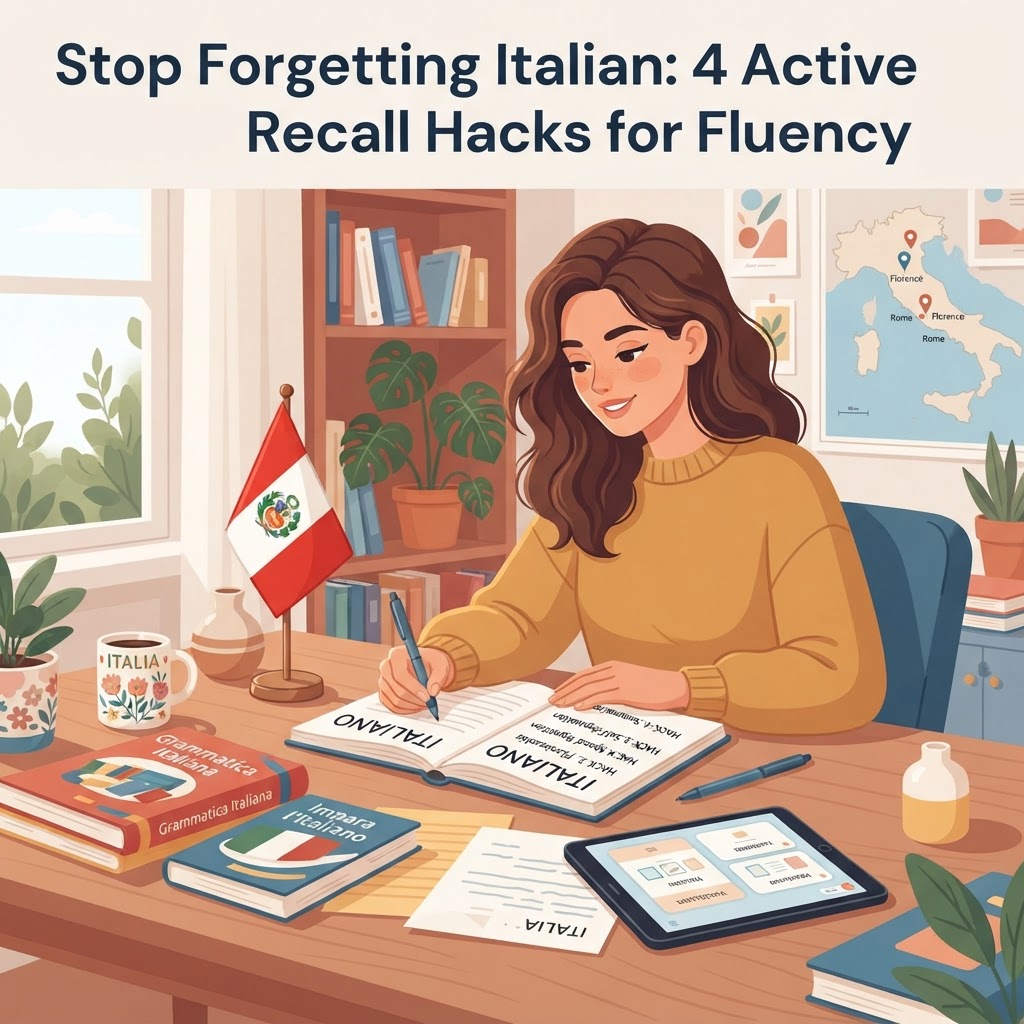
Stop Forgetting Italian: 4 Active Recall Hacks for Fluency

Stop Forgetting Your Italian: 4 Active Recall Hacks for Faster Fluency\n\nHave you ever spent an hour highlighting a textbook or re-reading your vocabulary lists, only to find that you cannot remember a single word when it is time to speak? This frustrating phenomenon is known as the "illusion of competence." According to research on Active Recall: A Smarter Way to Learn Italian, simply re-reading notes makes information feel familiar, but it does not actually help you retrieve it during a real conversation. \n\nAt Speakup Academy, led by certified educator Carmen Solari, we emphasize that true fluency comes from production, not just recognition. To bridge the gap between your self-study sessions and our live lessons, you need to move from passive reviewing to active retrieval. Here are four science-backed study hacks specifically tailored for the Italian language to help you master grammar and vocabulary once and for all.\n\n## 1. The "Blurting" Method for Italian Grammar\n\nOne of the most effective ways to identify gaps in your knowledge is the "blurting" method. Instead of looking at your grammar charts, take a blank piece of paper and a timer. Set the timer for five minutes and write down everything you know about a specific topic—for example, the Passato Prossimo or the use of indirect object pronouns. \n\nDon't worry about neatness; just "blurt" out the rules, the auxiliary verbs (essere vs. avere), and any irregular past participles you remember. As noted in Effective Active Recall Strategies for Language Learners, this forces your brain to reconstruct neural pathways. Once the timer is up, compare your "blurt" to your notes. The things you missed are your high-priority study areas. \n\nExample:\n* Ho mangiato una mela. (I ate an apple.) — Practice using avere as an auxiliary.\n* Sono andato al cinema. (I went to the cinema.) — Practice using essere for verbs of movement.\n\n## 2. The "Production-First" Flashcard Flip\n\nA common mistake among Italian learners is only practicing recognition—seeing the Italian word and knowing the English meaning. However, in a live session at Speakup Academy, you need to do the opposite: think of the English concept and produce the Italian word. \n\nTo hack your memory, always prioritize "English-to-Italian" flashcards. If you use apps like Anki or physical cards, look at the English prompt and try to say the Italian word out loud before checking the back. This mimics the cognitive load of real-life speaking. As Science Based Learning suggests, asking your brain to produce the target language before peeking at the answer is the key to long-term retention.\n\nExample:\n* Prompt: "The book is on the table."\n* Recall: Il libro è sul tavolo.\n\n## 3. The Feynman Technique for Verb Tenses\n\nNamed after physicist Richard Feynman, this technique involves explaining a complex concept in simple terms as if you were teaching it to a child. Italian verb tenses, such as the difference between the Imperfetto and the Passato Prossimo, can be notoriously tricky for English speakers. \n\nInstead of just memorizing rules, try to explain the logic out loud. Why do we use the Imperfetto for ongoing actions in the past? If you cannot explain it simply, you don't understand it well enough yet. This method is a staple in Carmen Solari’s teaching philosophy at Speakup Academy, where we encourage students to verbalize their understanding to solidify the logic behind the language.\n\nExample:\n* Mentre studiavo, il telefono ha suonato. (While I was studying [ongoing/Imperfetto], the phone rang [interruption/Passato Prossimo].)\n\n## 4. Mental Narration: The "Radio Me" Technique\n\nYou don't need a partner to practice active recall. You can turn your daily routine into a retrieval exercise by narrating your actions in Italian. This is a form of contextualized recall that makes the language functional. \n\nAs you go about your day, ask yourself: "How do I say 'I am making coffee' or 'I need to find my keys'?" If you don't know a word, don't look it up immediately. Try to describe the object using words you do know (circumlocution). This builds the mental flexibility required for fluent conversation.\n\nExample:\n* Adesso preparo il caffè. (Now I am preparing the coffee.)\n* Dove sono le mie chiavi? (Where are my keys?)\n\n## Key Takeaways for Your Italian Journey\n\nMastering Italian is not about how many hours you spend looking at a book; it is about how many times you challenge your brain to retrieve information. By using the blurting method, focusing on production-first flashcards, teaching concepts via the Feynman technique, and narrating your life, you will find that your progress accelerates significantly. \n\nRemember, these hacks are most effective when paired with real-world application. At Speakup Academy, our live lessons are designed to be the ultimate active recall environment, where Carmen and our expert tutors help you put these retrieved memories into practice. Start small, be consistent, and soon, the Italian language will feel like second nature. In bocca al lupo! (Good luck!)