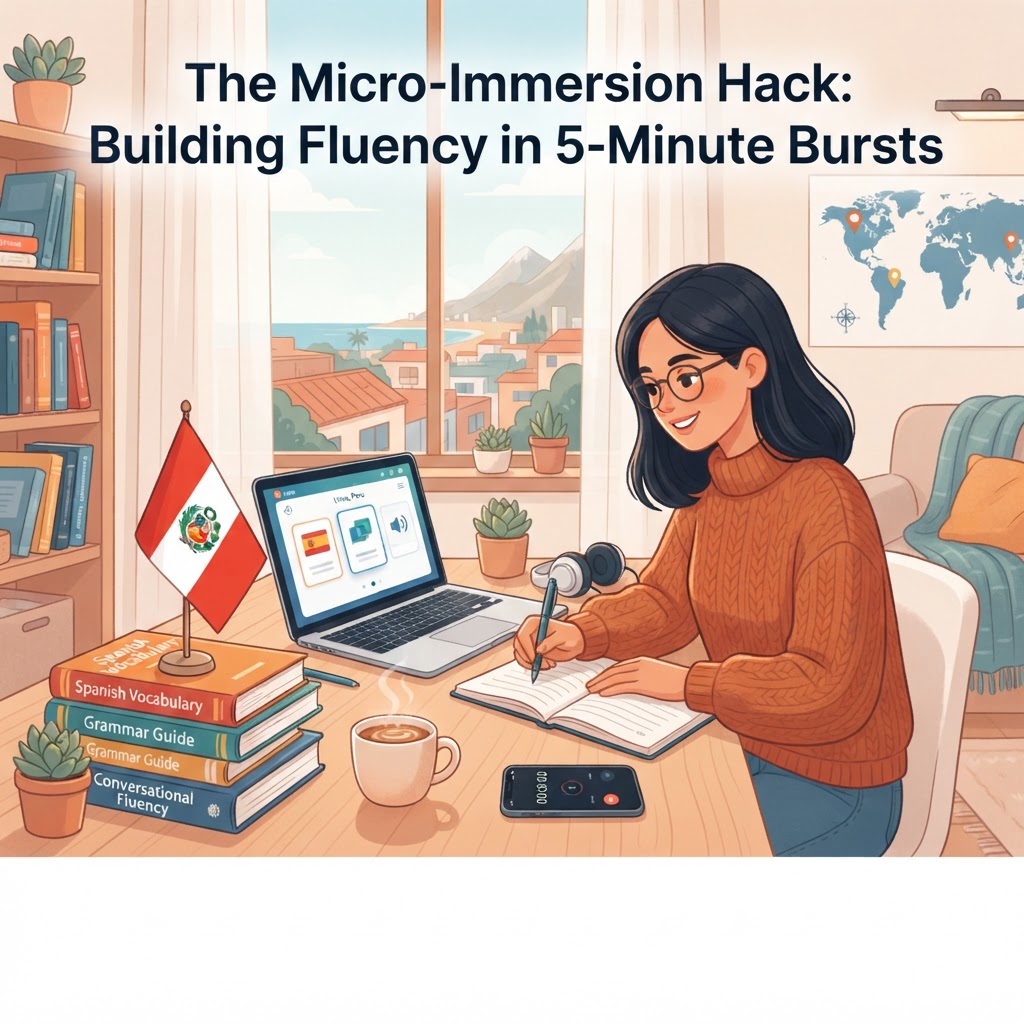
For many adult language learners, the biggest hurdle isn't a lack of talent or resources—it is a perceived lack of time. We often imagine that fluency requires hours of uninterrupted study or a plane ticket to Rome, Madrid, or London. However, cognitive science suggests a different path. By leveraging "Micro-Immersion" and "Active Recall," you can transform the "dead time" in your day—your commute, your coffee break, or your wait in line—into high-intensity learning sessions that rival full-time study.
At Speakup Academy, we see this daily. While our live lessons with Carmen Solari provide the essential human connection and real-time feedback needed for fluency, the students who progress the fastest are those who master the art of the "study hack" between sessions. Today, we are diving deep into how you can use the science of memory to make your target language a permanent part of your brain.
The Science of Active Recall vs. Passive Review
Most students study by re-reading notes or highlighting textbooks. Research shows this is one of the least effective ways to learn. This is known as "passive review," where you recognize information but cannot necessarily produce it. To truly learn, you must use Active Recall.
Active recall is the process of pulling information from your brain without prompts What is active recall? - Pearson. Instead of looking at a word and its translation, you look at the concept and force your brain to retrieve the target word. This "mental struggle" strengthens the neural pathways. According to studies, this method significantly outperforms traditional study because it moves information from short-term to long-term memory Ways to Use Active Recall for Faster Language Learning - Pimsleur.
Mastering Spaced Repetition (SRS)
If active recall is the how of learning, Spaced Repetition (SRS) is the when. Spaced repetition is an evidence-based technique where you review vocabulary at increasing intervals Spaced repetition.
Imagine you learn a new Italian verb today. If you review it tomorrow, then three days later, then a week later, you are hitting the "refresh" button on your memory just as it is about to fade. This is much more effective than "cramming" for three hours once a week. Digital tools like Anki or Memrise use algorithms to automate this, ensuring you only see the words you are about to forget Spaced Repetition: Master Any Language Fast - Busuu.
At Speakup Academy, we encourage students to take the phrases they struggle with during Carmen’s live lessons and plug them immediately into an SRS app. This ensures that a mistake made on Tuesday becomes a mastered phrase by Friday.
Designing Your Micro-Immersion Environment
Immersion doesn't require moving to a new country; it requires changing your environment. "Micro-immersion" is the practice of surrounding yourself with the language in small, manageable ways The Truth About Language Immersion.
- The Phone Swap: Change your smartphone's system language. You already know where the "Settings" or "Camera" icons are; seeing them in Spanish or Italian daily builds effortless vocabulary.
- Narrate Your Life: As you cook or clean, describe your actions out loud. If you don't know the word for "spatula," that is your cue to look it up and add it to your SRS.
- Audio Chunks: Listen to 5-minute podcasts or news snippets during your commute. Even if you don't understand every word, you are training your ear to the rhythm and phonetics of the language Immersion Learning Explained.
Practical Examples for Your Next Session
To get you started, here are a few high-frequency "chunks" that you can practice using active recall today. Try covering the translation and seeing if you can produce the phrase from memory.
Spanish (Español):
- Phrase: "¿Podría repetir eso más despacio, por favor?"
- Translation: "Could you repeat that more slowly, please?"
- Context: Essential for keeping the conversation going when a native speaker gets too fast.
Italian (Italiano):
- Phrase: "Mi sono perso, mi può aiutare?"
- Translation: "I am lost, can you help me?"
- Context: A vital survival phrase that uses the reflexive "mi sono" and the formal "può."
English (Inglés):
- Phrase: "I’m looking forward to our next meeting."
- Translation: "Estoy ansioso por nuestra próxima reunión."
- Context: A common professional idiom that is often used incorrectly by learners.
Bridging the Gap to Live Lessons
These study hacks are powerful, but they are the "gym" where you build the muscle. The "game" happens during live interaction. The goal of micro-immersion and active recall is to lower your cognitive load so that when you sit down for a live lesson at Speakup Academy, you aren't struggling to remember basic words. Instead, you can focus on complex expression, cultural nuances, and the joy of real communication with Carmen.
By automating the basics through 5-minute bursts of study, you free up your brain to handle the spontaneous, beautiful messiness of real-world conversation.
Key Takeaways
- Prioritize Active Recall: Stop reading; start retrieving. Test yourself constantly.
- Use Spaced Repetition: Review in small intervals (1, 3, 7, 14 days) to beat the forgetting curve.
- Micro-Immerse: Change your digital environment and narrate your daily tasks to build "passive" familiarity.
- Consistency Over Intensity: Five minutes every day is significantly more effective than a three-hour marathon once a week.
- Prepare for Live Practice: Use these hacks to build the foundation so your live lessons with Speakup Academy can focus on true fluency.