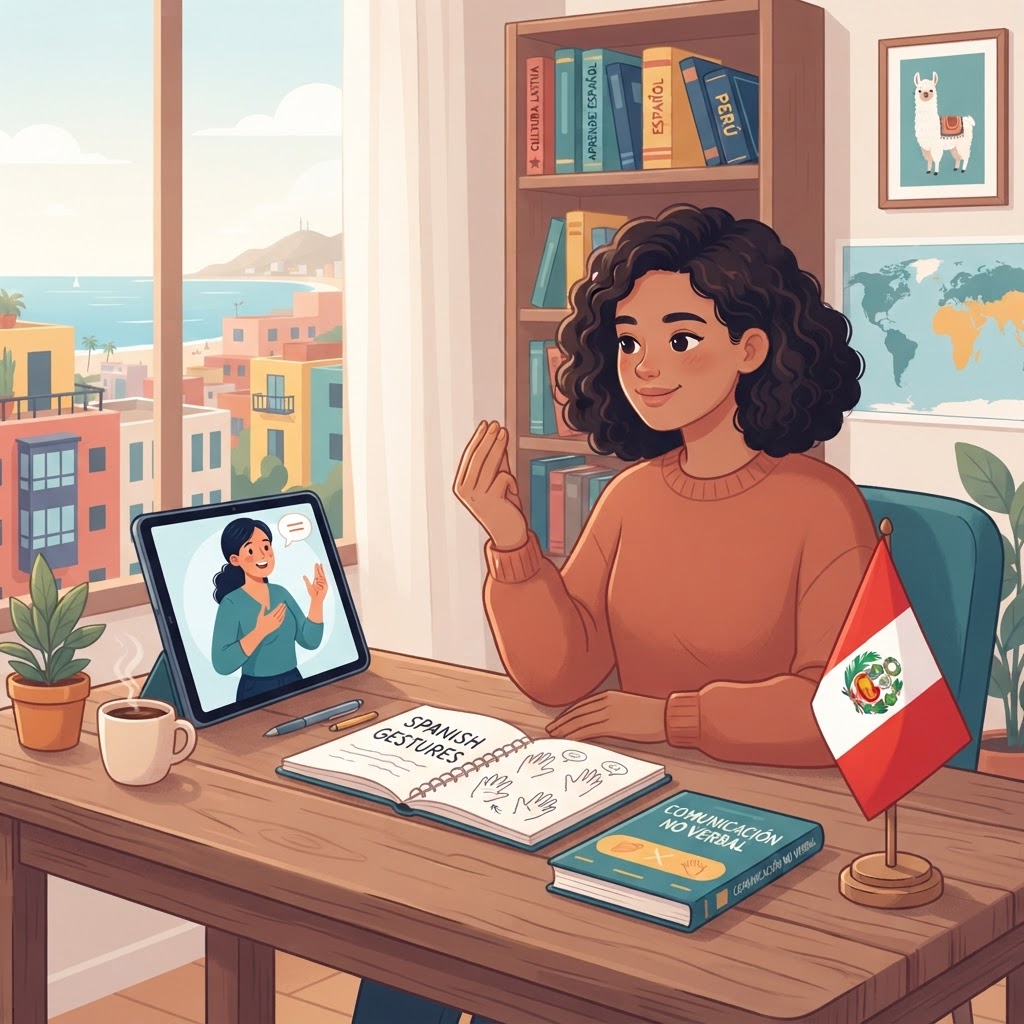
Beyond Words: Mastering the Silent Language of Spanish Gestures
When you start your journey with Spanish, your focus is naturally on the 'visible' parts of the language: the rolling 'r', the tricky subjunctive mood, and the endless list of vocabulary. But as any student at Speakup Academy will tell you, there is a hidden layer of communication that textbooks often overlook. In the Spanish-speaking world, the body speaks just as loudly as the tongue.
Spanish is a high-context, expressive language. Whether you are in a bustling market in Lima or a tapas bar in Madrid, you will notice that native speakers use their hands, faces, and even their proximity to others to convey meaning. If you only focus on the words, you are only getting half the story. Mastering these nonverbal cues is the secret to moving from 'someone who speaks Spanish' to 'someone who communicates in Spanish.'
The Expressive Power of Spanish Nonverbal Cues
In many English-speaking cultures, excessive gesturing can be seen as distracting or overly dramatic. In Spanish culture, however, it is a sign of engagement and passion. Using your hands to emphasize a point isn't just an add-on; it is a fundamental part of the syntax.
Carmen Solari, our lead educator at Speakup Academy, often emphasizes that 'fluency is a full-body experience.' When you incorporate natural gestures, you actually reduce the cognitive load on your brain. If your hands are helping you describe the size, emotion, or urgency of a situation, your mind can focus more easily on retrieving the correct verb conjugation. It makes you appear more confident, even if your grammar isn't perfect yet.
4 Essential Gestures to Use Today
To help you blend in during your next conversation, let’s look at four concrete examples of gestures used across the Spanish-speaking world. These are practical tools you can start using immediately in your live lessons or during your next trip.
1. The 'Pasta' Gesture (Money)
The Action: Rub your thumb against the tips of your index and middle fingers. The Meaning: This refers to money (dinero), specifically that something is expensive or that someone has a lot of wealth. In Spain, 'pasta' is common slang for money. Example: 'Ese coche cuesta mucha pasta.' (That car costs a lot of money.)
2. The Chin Flick (I Have No Idea)
The Action: Place the back of your fingers under your chin and flick them outward toward the person you are talking to. The Meaning: This is a shorthand for 'No tengo ni idea' or 'Yo qué sé' (I have no clue). It is often accompanied by a slight shrug. Example: '¿A qué hora llega el autobús?' — [Chin flick] — 'Ni idea.' (What time does the bus arrive? — No clue.)
3. Tapping the Cheek (To Have Nerve)
The Action: Tap your cheek repeatedly with your index finger or the palm of your hand. The Meaning: This indicates that someone is 'un caradura' or has 'mucha cara'. It means they are cheeky, shameless, or have a lot of nerve. Example: 'Él nunca paga la cuenta; tiene mucha cara.' (He never pays the bill; he has a lot of nerve.)
4. The Finger-Licking Sign (Delicious)
The Action: Bring your fingertips to your lips, blow a small kiss, and spread your fingers outward. The Meaning: This signifies that food is excellent. It corresponds to the phrase 'está para chuparse los dedos'. Example: '¡Esta paella está para chuparse los dedos!' (This paella is finger-licking good!)
Navigating Physical Space and Greetings
Beyond hand signals, Spanish culture has a different definition of 'personal space' than many other cultures. It is common for native speakers to stand closer together during a conversation and to use light physical touch—such as a pat on the arm or a hand on the shoulder—to show warmth and connection.
Greetings are another area where nonverbal rules are paramount. In Spain, the dos besos (two kisses, starting with the right cheek) is the standard for social introductions between women, or between men and women. In many Latin American countries, a single kiss is more common. For men, a firm handshake is the go-to, often evolving into a 'bro-hug' (el abrazo) once a friendship is established. At Speakup Academy, we practice these social nuances in our live sessions so that our students feel comfortable and respectful in any social setting.
Avoiding Common Nonverbal Faux Pas
While being expressive is encouraged, there are a few 'silent' mistakes to avoid. For instance, pointing directly at someone with your index finger can be seen as aggressive or rude in many Spanish-speaking regions. Instead, it is better to gesture with your whole hand or use a subtle nod of the head.
Additionally, be careful with the 'OK' sign (forming a circle with your thumb and index finger). While common in the US, in some contexts and countries, it can be interpreted as an insult. When in doubt, a simple thumbs-up is a much safer way to signal that everything is good.
Key Takeaways for the Savvy Learner
Mastering Spanish is about more than just what comes out of your mouth; it is about how you present yourself to the world. By observing and adopting these cultural nuances, you bridge the gap between being a visitor and being a participant in the culture.
- Observe first: Watch Spanish-language films or interviews and pay attention to the hands, not just the subtitles.
- Start small: Pick one gesture, like the 'pasta' sign, and try to use it naturally in your next conversation.
- Embrace the warmth: Don't be afraid of the closer physical proximity; it is a sign of cultural inclusion.
- Practice in context: Use your live lessons with Carmen Solari to ask about regional variations in body language.
Learning these 'silent words' will not only make you more fluent but will also help you build deeper, more authentic connections with the Spanish-speaking community. ¡A practicar!