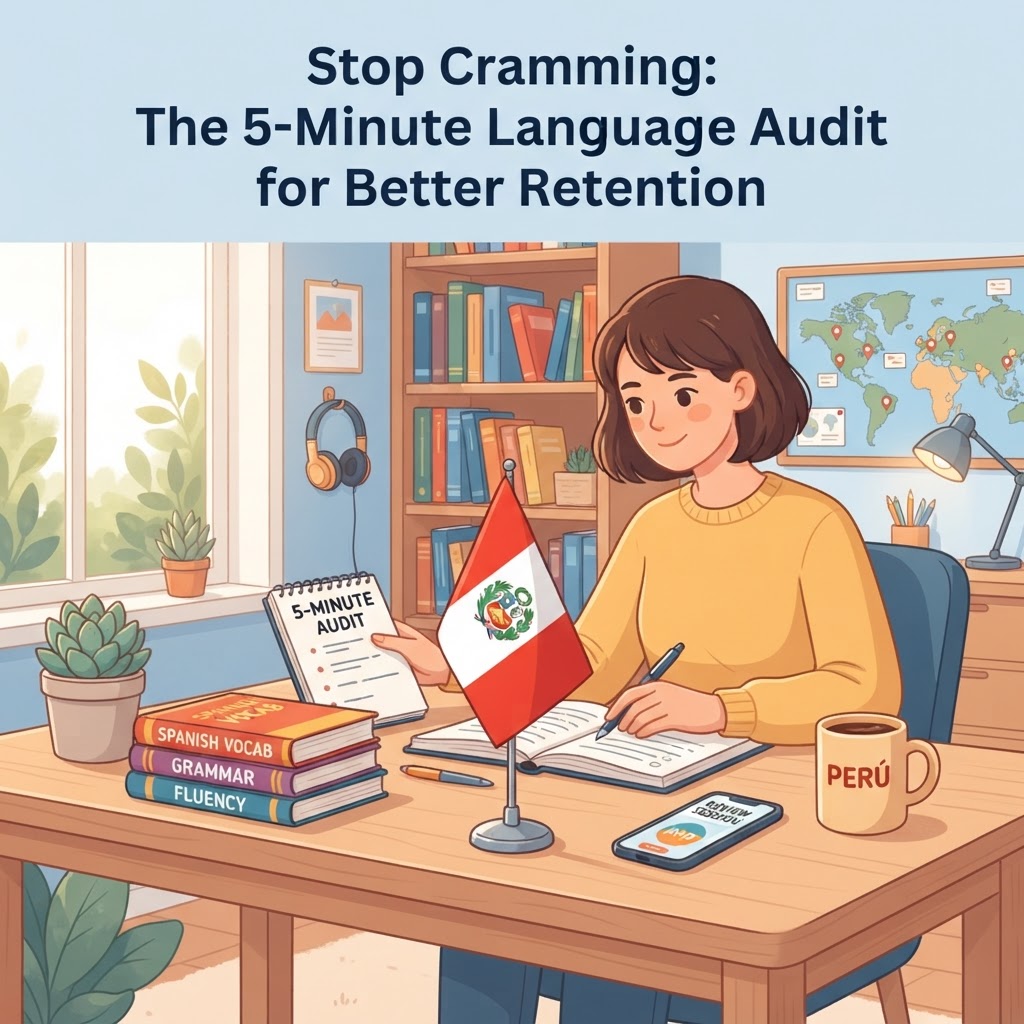
The Hidden Cost of Passive Review
Many language learners fall into a common trap: they spend hours reviewing notes, re-reading textbooks, or passively listening to podcasts, only to find that the vocabulary slips away the moment they need it in a real conversation. At Speakup Academy, we often see students who are putting in the effort but missing the strategy. The problem isn't your memory; it's the lack of an active audit. Research shows that auditing your learning routine—comparing what you actually remember versus what you think you know—can boost retention by up to 18%.
What is a Language Audit?
A language audit is not a test; it is a diagnostic tool. Instead of mindlessly flipping through flashcards, you set a timer for five minutes and force your brain to retrieve information without any prompts. If you cannot recall a word or a grammatical structure within five seconds, mark it as a 'gap.' These gaps are your only priority for the next study session. By focusing exclusively on what you have forgotten, you stop wasting time on what you already know, effectively hacking your brain's forgetting curve.
Implementing Active Recall in Your Routine
To make this work, you must move away from passive recognition. When you are preparing for your live lessons with Carmen, try these three active recall exercises to test your knowledge:
-
The Reverse Translation: Take a sentence you learned in your last session and translate it into your native language. Then, hide the original and try to translate it back into your target language. For example, if you are learning Spanish: 'Me gustaría reservar una mesa para dos' (I would like to book a table for two). Can you reconstruct that sentence perfectly without looking?
-
The Contextual Swap: Take a phrase and change the subject or tense. If you know 'I am eating an apple' (English: 'I am eating an apple' / Italian: 'Sto mangiando una mela'), try to change it to 'We are eating an apple.' This forces you to apply grammar rules actively rather than just memorizing a static phrase.
-
The 'Explain It' Method: Pretend you are teaching a concept to a friend. If you can explain why you use a specific verb conjugation or a certain preposition, you have mastered it. If you stumble, that is your audit gap.
Aligning with Your Circadian Peaks
Beyond the audit, timing is everything. Research suggests that aligning your most challenging study tasks with your natural circadian peaks—the times of day when you feel most alert—can boost retention by 25%. If you are a morning person, do your vocabulary audit between 9:00 AM and 11:00 AM. If you are a night owl, save your complex grammar exercises for your peak evening hours. At Speakup Academy, we encourage our students to schedule their live sessions during these high-energy windows to maximize the benefit of Carmen’s personalized feedback.
Setting a Frustration Ceiling
Finally, protect your motivation. If your recall accuracy dips below a certain threshold, do not force yourself to continue. Switch tasks. If you are struggling with verb conjugations, switch to listening or reading for ten minutes. This 'frustration ceiling' prevents burnout and keeps your brain in a state of 'desirable difficulty' rather than pure exhaustion. Remember, language learning is a marathon, not a sprint.
Key Takeaways
To improve your retention, stop reviewing everything equally. Use a 5-minute audit to identify your specific knowledge gaps, practice active recall by reconstructing sentences from scratch, and align your study sessions with your peak energy hours. By auditing your progress regularly, you will find that your live sessions become much more productive, allowing you to focus on fluency rather than just memorization.