Understanding the Reflexive Concept
If you have ever wondered why Italians say "Mi chiamo" (I call myself) instead of just "I am called," you have already encountered the world of reflexive verbs. In Italian, reflexive verbs are essential for describing actions that the subject performs on themselves. While they might seem intimidating at first, they are the building blocks of everyday conversation, from your morning routine to expressing your feelings.
At Speakup Academy, Carmen Solari often emphasizes that reflexive verbs are not just a grammatical exercise; they are a window into how Italians structure their daily lives. By mastering these, you move away from translating word-for-word and start thinking in the rhythm of the language.
The Mechanics: How to Form Them
To form a reflexive verb, you need two components: the reflexive pronoun and the conjugated verb. The pronouns you will use are mi, ti, si, ci, vi, si. These must always precede the conjugated verb in simple tenses.
For example, take the verb lavarsi (to wash oneself):
- Io mi lavo (I wash myself)
- Tu ti lavi (You wash yourself)
- Lui/Lei si lava (He/she washes himself/herself)
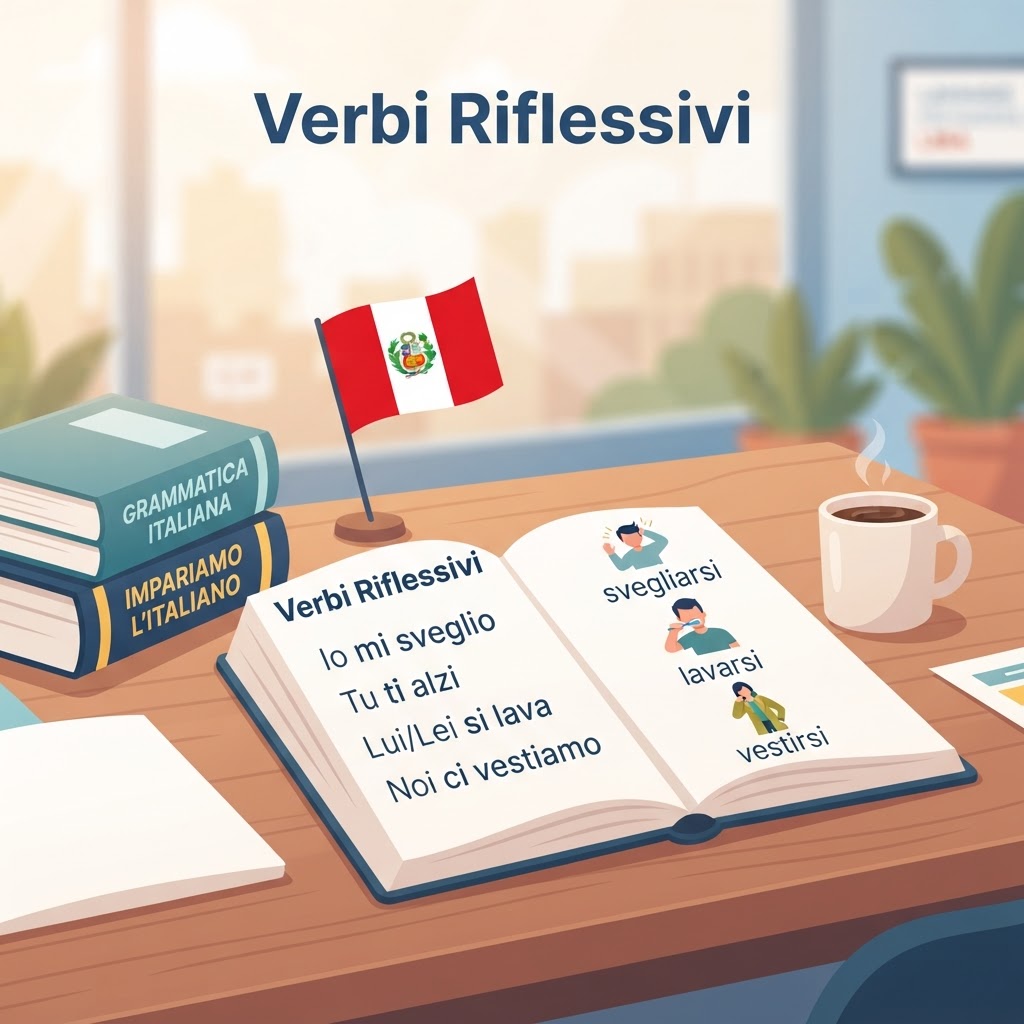
Notice how the pronoun changes to match the subject. This consistency is your best friend. Once you memorize the pattern, you can apply it to hundreds of other verbs like svegliarsi (to wake up) or vestirsi (to dress oneself).
The "Body Part" Rule
One of the most common mistakes students make is using possessive adjectives (like "my" or "your") when talking about body parts. In Italian, when you perform an action on your own body, you use the reflexive verb and the definite article instead of a possessive adjective.
Instead of saying "I wash my hands" as Lavo le mie mani, you should say:
- Mi lavo le mani. (I wash my hands.)
This rule applies to clothing as well. If you are putting on your coat, you say:
- Ti metti il cappotto. (You put on your coat.)
This is a subtle shift, but it is exactly the kind of detail that helps you sound like a native speaker during your live sessions with Carmen.
Complex Tenses and the Auxiliary Verb
When you move beyond the present tense into compound tenses (like the passato prossimo), there is one golden rule: reflexive verbs always take essere as their auxiliary verb, never avere.
For example:
- Mi sono svegliato/a presto. (I woke up early.)
Because you are using essere, remember that the past participle must agree in gender and number with the subject. If you are a woman, you would say svegliata; if you are a man, svegliato. This is a great topic to practice during your next Speakup Academy lesson to ensure your agreement is spot on.
Reciprocal Actions
Reflexive verbs can also express reciprocal actions—things people do to each other. In this case, the reflexive pronoun takes on the meaning of "each other."
- I miei amici si amano. (My friends love each other.)
This adds a layer of depth to your storytelling, allowing you to describe relationships and interactions with ease. Whether you are talking about your family or your colleagues, these verbs provide the necessary nuance to keep your conversations flowing naturally.
Key Takeaways
Reflexive verbs are the key to unlocking natural Italian. Remember: always use the correct reflexive pronoun, use the definite article for body parts instead of possessives, and always pair reflexive verbs with essere in compound tenses. Keep practicing these in your daily routine, and don't hesitate to bring your questions to your next live session at Speakup Academy. With consistent practice, these structures will soon become second nature.