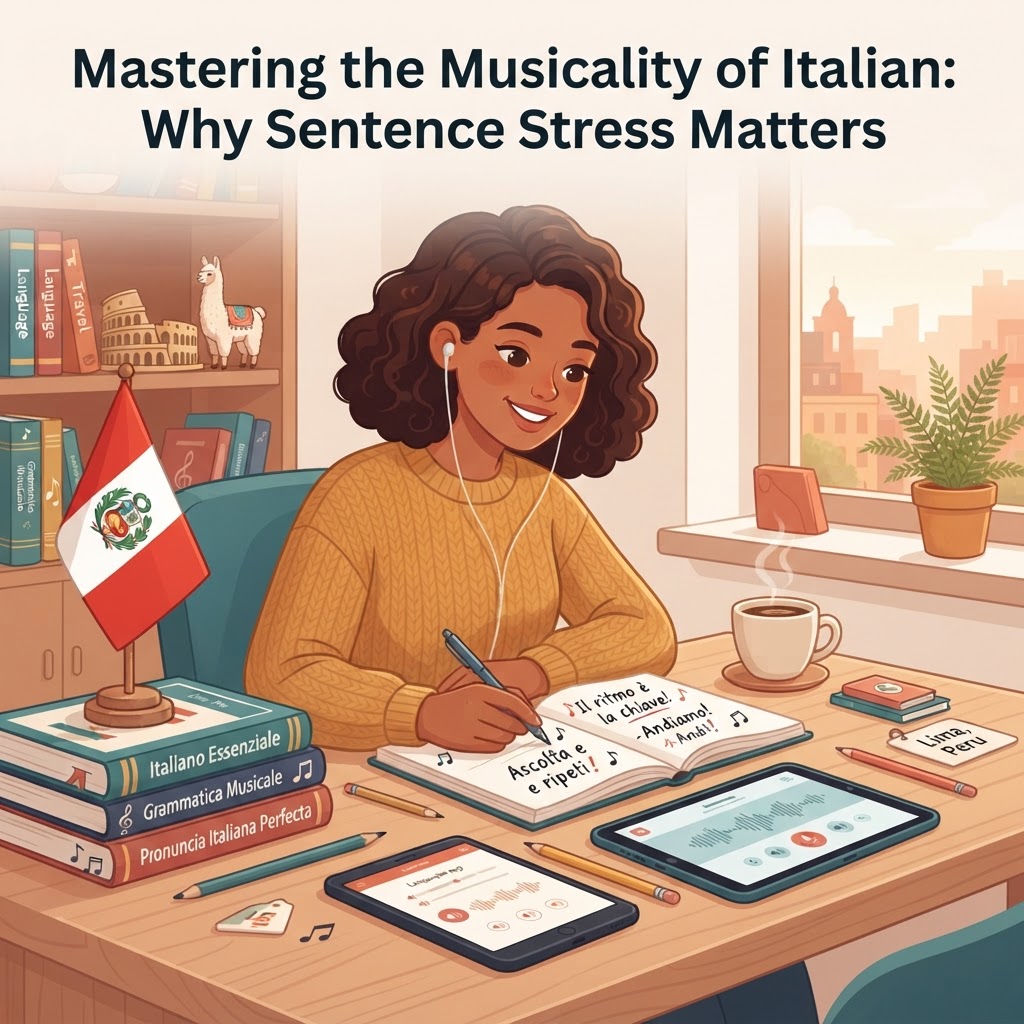
When you start learning Italian, it is easy to become obsessed with getting every vowel perfectly crisp. While pronunciation matters, many students hit a plateau where they sound 'correct' but not 'authentic.' The secret ingredient isn't a single sound—it is the musical rhythm of the language, or what linguists call sentence stress. At Speakup Academy, Carmen Solari often reminds our students that Italian is a language of melody. If you treat every word with the same weight, your speech will sound flat. To truly master the flow, you need to understand how to lengthen stressed syllables and let the rest of the sentence glide. ## The 'Long Vowel' Trick In Italian, when a syllable is stressed, it doesn't just get louder; it gets longer. Native speakers hold the stressed vowel slightly longer than the unstressed ones. This creates that iconic 'bouncy' rhythm that makes Italian so recognizable. If you cut these vowels too short, your speech will sound rushed or robotic. ## Rhythm in Action: Phrase Examples Try saying these phrases out loud, exaggerating the length of the bolded vowel. Feel how the rhythm changes the sound of the entire phrase: * Par-LAA-re (To speak): Notice how the stress on the 'a' makes the word feel like it has two distinct parts. * Ti a-MO (I love you): The stress falls on the 'o,' giving the phrase a soft, falling melody at the end. * Vò-glio un CAF-fè (I want a coffee): Notice the contrast between the quick 'voglio' and the long, accented 'caffè.' ## Stop Over-Pronouncing the Endings One common mistake adult learners make is giving every single syllable equal importance, especially at the end of words. In natural Italian speech, unstressed vowels at the end of a sentence often become very soft, almost swallowed. When you are in our live lessons, listen closely to how Carmen blends the end of one word into the start of the next. This 'linking' is what prevents that choppy, word-by-word delivery. ## Practice: The 'Sing-Song' Exercise To improve your sentence stress, try reading a sentence while slightly over-emphasizing the melody, almost like you are singing it. It sounds silly at first, but it trains your mouth muscles to prioritize the rhythm over the individual phonemes. Once you get the melody down, you can dial back the exaggeration until it sounds natural. ## Key Takeaways * Lengthen, don't just shout: Italian stress is about duration, not just volume. * Focus on the flow: Stop treating words as isolated units; practice linking them to maintain rhythm. * Listen actively: In your next live session at Speakup Academy, observe how the melody of the sentence changes the meaning and emotion behind the words. * Embrace the melody: Italian is meant to be musical—don't be afraid to let your voice rise and fall.
Pronunciation·October 8, 2026
Mastering the Musicality of Italian: Why Sentence Stress Matters
Stop worrying about individual sounds and start focusing on Italian sentence stress. Learn how intonation and rhythm make you sound like a native speaker.