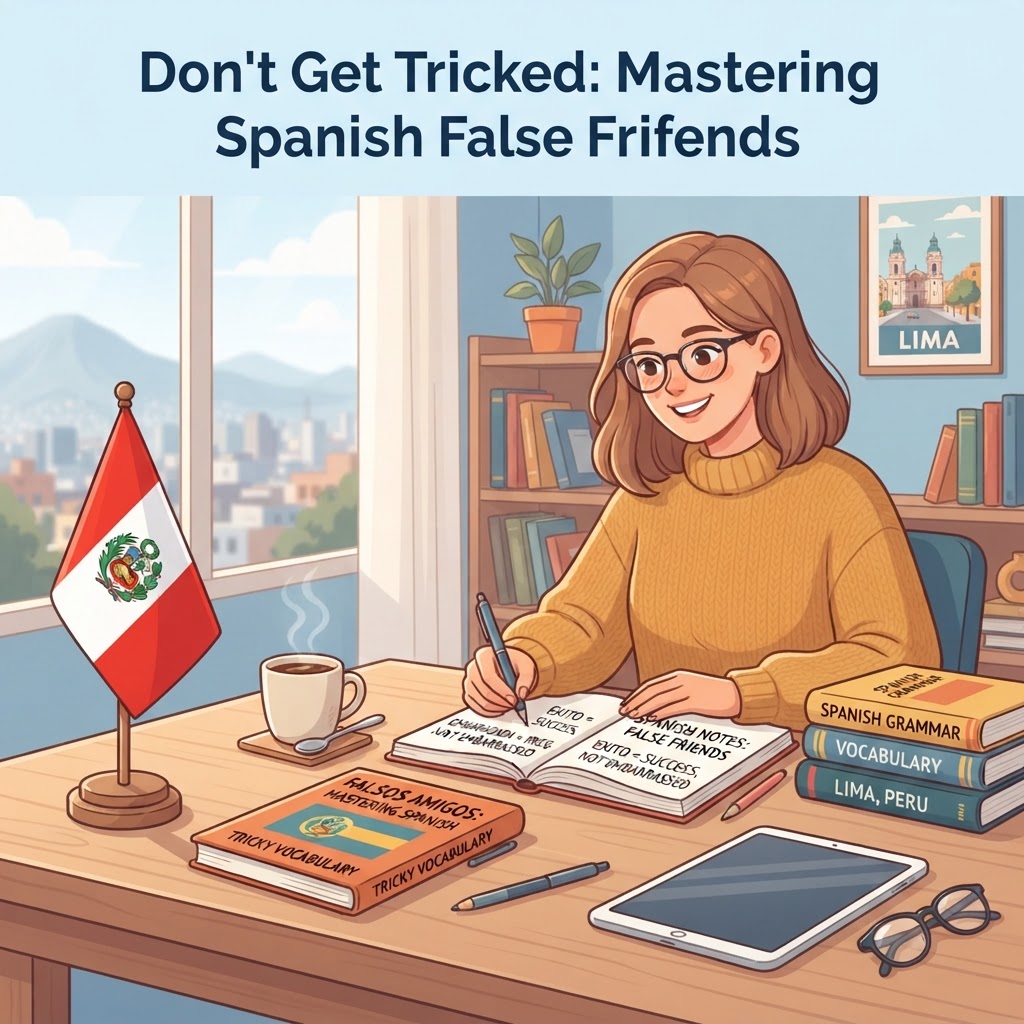
The Trap of Familiarity
As you progress in your Spanish journey, you will inevitably encounter words that look suspiciously like their English counterparts. These are often called 'cognates'—words that share a common root and meaning, like 'hospital' or 'animal'. However, the real danger lies in 'false friends' (falsos amigos). These are words that share a similar spelling or sound but carry completely different meanings. Falling for these traps is a rite of passage for every learner, but with a little awareness, you can avoid the most common pitfalls.
At Speakup Academy, we often see students trip over these during our live sessions. Carmen Solari always emphasizes that the key isn't to memorize a dictionary, but to learn these words in context so your brain recognizes the pattern rather than the literal translation.
1. Embarazada vs. Embarrassed
Perhaps the most famous false friend of all is 'embarazada'. It sounds so much like 'embarrassed' that many beginners accidentally announce to the world that they are pregnant. If you feel shy or awkward, the correct word is 'avergonzado' (for a man) or 'avergonzada' (for a woman).
- Incorrect: Estoy muy embarazada. (I am very pregnant.)
- Correct: Estoy muy avergonzado. (I am very embarrassed.)
2. Actual vs. Actualmente
In English, 'actually' means 'in fact'. In Spanish, 'actual' means 'current' or 'present'. If you want to say 'actually' in Spanish, you should use 'en realidad' or 'de hecho'.
- Example: Actualmente vivo en Lima. (I currently live in Lima.)
- Example: En realidad, no tengo hambre. (Actually, I am not hungry.)
3. Librería vs. Library
This is a classic mistake for book lovers. If you are looking for a place to borrow books for free, you are looking for a 'biblioteca'. A 'librería' is a bookstore where you go to purchase your next read.
- Example: Voy a la biblioteca para estudiar. (I am going to the library to study.)
- Example: Compré este libro en la librería. (I bought this book at the bookstore.)
4. Éxito vs. Exit
When you are looking for the way out of a building, you are looking for the 'salida'. If you see the word 'éxito', you are looking at the word for 'success'. Confusing these two can lead to some very confusing moments when navigating a new city!
- Example: La salida está a la derecha. (The exit is to the right.)
- Example: ¡Te deseo mucho éxito en tu examen! (I wish you much success on your exam!)
How to Stop the Guesswork
The best way to internalize these differences is through active use. Instead of just reading lists, try to use these words in sentences during your next conversation practice. If you are currently enrolled in live lessons with Carmen, try incorporating one of these 'false friends' into your next speaking exercise. By making a mistake in a safe, supportive environment, you are much less likely to make it in the real world.
Remember, language learning is a marathon, not a sprint. Every time you catch yourself about to use a false friend, you are building the 'cultural intuition' that separates a mechanical translator from a true speaker.
Key Takeaways
- False friends are words that look similar in English and Spanish but have different meanings.
- Always verify the meaning of a word if it seems too convenient to be true.
- Context is your best tool: learn these words through reading, listening, and speaking rather than rote memorization.
- Don't be afraid of making mistakes; they are the fastest way to cement the correct usage in your memory.