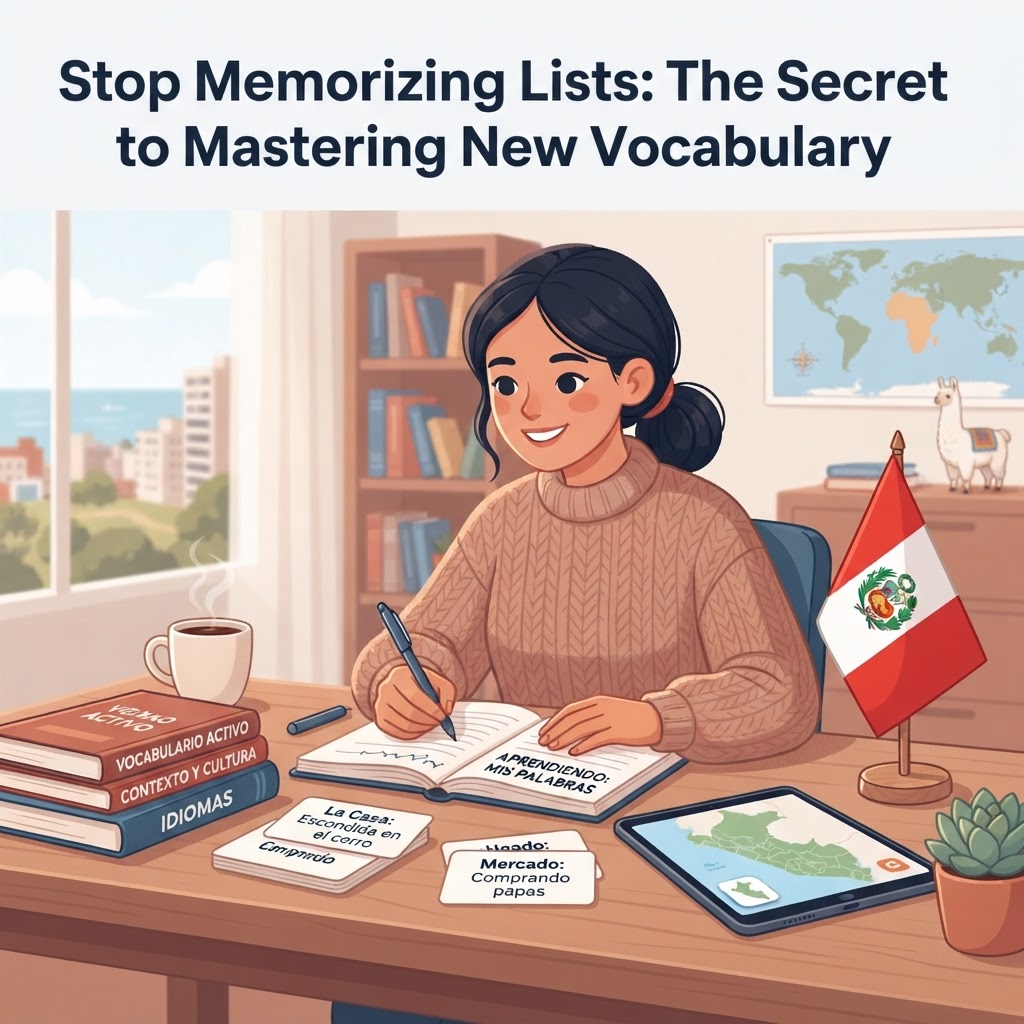
Why Your Vocabulary Lists Aren't Working
We have all been there: you spend an hour writing down a long list of new words, translating them into your native language, and repeating them until your head spins. Yet, when you sit down for a live session with your teacher, those words seem to vanish into thin air. The problem isn't your memory; it is the method. At Speakup Academy, we often see students struggling because they treat language like a collection of isolated facts rather than a living, breathing system. To truly master vocabulary, you need to stop memorizing and start connecting.
The Power of Contextual Chunks
Instead of learning individual words, focus on "chunks"—small groups of words that naturally go together. When you learn a word in isolation, you miss out on its grammatical behavior and its natural environment. By learning phrases, you automatically absorb how a word functions in a real sentence. For example, don't just learn the verb 'decide.' Learn the phrase 'decide to do something.'
- English: "I decided to take a walk." (Instead of just 'decide')
- Spanish: "Me di cuenta de que..." (I realized that... - instead of just 'cuenta')
- Italian: "Fare una bella figura" (To make a good impression - a common cultural idiom)
Create Personal Scenarios
Your brain is wired to remember information that feels relevant to your own life. If you are learning vocabulary related to travel, don't just memorize a list of airport terms. Visualize yourself standing at the check-in counter. What are you actually saying? What is the agent asking you? By creating a mental movie, you anchor the vocabulary to a specific, emotional, or practical experience. During your lessons with Carmen, try to bring these personal scenarios to the table. When you use a new word to describe your own weekend or your own goals, it moves from your short-term memory to your long-term storage.
The 'Use It or Lose It' Rule
There is no substitute for active production. You can read a word a hundred times, but until you have used it in a conversation, you don't truly own it. Make it a game to incorporate one or two 'new' words into every conversation you have this week. If you are worried about making a mistake, remember that errors are simply data points for improvement. At Speakup Academy, our live sessions are designed to be a safe space where you can 'test drive' your new vocabulary in real-time with expert guidance.
Spaced Repetition: Quality Over Quantity
Finally, stop trying to cram. Research shows that reviewing a word five minutes a day for a week is significantly more effective than studying it for an hour once a week. Use a simple notebook or a digital app to track your 'target words' and revisit them at increasing intervals. If you learned a word today, look at it again tomorrow, then in three days, then in a week. This 'spaced repetition' ensures that the word stays fresh without requiring massive amounts of study time.
Key Takeaways
To build a lasting vocabulary, shift your focus from quantity to quality. Learn words in context, create personal scenarios that make the language meaningful, and prioritize active usage over passive reading. Remember, language learning is a marathon, not a sprint. By integrating these small, consistent habits into your routine, you will find that your ability to express yourself grows naturally and confidently.