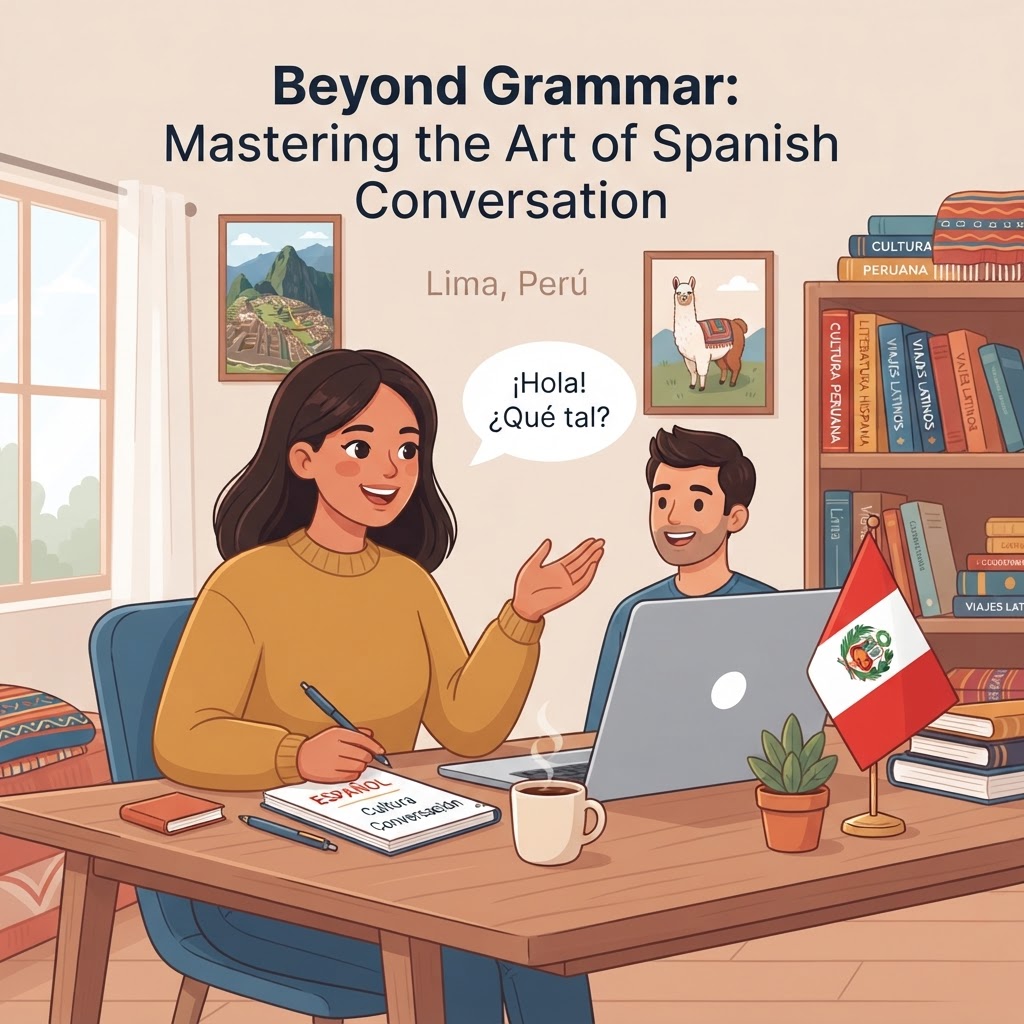
The Hidden Language of Connection
When you study a language, it is easy to focus entirely on verb conjugations and vocabulary lists. However, as many students at Speakup Academy discover during their live sessions with Carmen, language is only half the battle. To truly communicate in Spanish, you must understand the 'music' of the conversation—the tone, the rhythm, and the unwritten social rules that govern how people interact.
Spanish is a high-context language. This means that meaning is often found not just in the words themselves, but in the shared cultural understanding, body language, and situational cues. If you have ever felt like you understood the words but missed the 'point' of a conversation, you are likely experiencing the difference between linguistic fluency and cultural fluency.
Why 'Loud' is Actually 'Engaged'
If you come from a culture that values quiet, reserved communication, a typical Spanish-speaking gathering might feel overwhelming. You might hear multiple people talking at once, raised voices, and frequent interruptions. In many English-speaking contexts, this would be considered rude or aggressive. In the Spanish-speaking world, it is the opposite.
Overlapping speech and high volume are signs of engagement and enthusiasm. When a friend interrupts you, they aren't trying to silence you; they are so excited by your point that they want to join in immediately.
- Example: If someone says, "¡No me digas!" (Don't tell me! / You don't say!) while you are mid-sentence, they are showing active interest in your story.
- Pro Tip: Don't wait for a long silence to jump into a conversation. In Spanish, silence can sometimes be interpreted as a lack of interest or a lull in the friendship. Jump in when you feel the energy!
The Dance of 'Tú' and 'Usted'
One of the most common cultural hurdles for learners is the distinction between the informal tú and the formal usted. This is not just a grammar rule; it is a social negotiation. Using tú too early with a stranger or an authority figure can seem presumptuous, while sticking to usted after being invited to use tú can create an unnecessary wall of distance.
- Example: "¿Me puede ayudar, por favor?" (Can you help me, please? - Formal/Usted)
- Example: "¿Me ayudas con esto?" (Can you help me with this? - Informal/Tú)
At Speakup Academy, we often practice these transitions. Remember, the invitation to 'tutear' (switch to the informal tú) is a warm social signal. When someone says, "¡Túrame!" or "No hace falta el usted," they are welcoming you into a closer circle of trust.
The Power of Non-Verbal Cues
Spanish communication relies heavily on the body. From the way people stand to the gestures they use, your physical presence is part of your message. In many Spanish-speaking countries, personal space is smaller than in the U.S. or Northern Europe. Friends often touch arms during conversation or greet with a kiss on the cheek.
- Example: A light touch on the arm while speaking is a common way to emphasize a point or express warmth, not a sign of romantic interest.
- Example: A quick flick of the fingers under the chin (the 'chin flick') is a common gesture meaning "I don't know" or "I don't care."
If you find yourself backing away during a conversation, try to stay present. Observing how native speakers use their hands and facial expressions will help you decode the emotional weight behind their words.
The Importance of the Greeting
Never underestimate the power of a proper greeting. In many Spanish-speaking cultures, walking into a shop or an office and immediately asking a question is considered abrupt. Always start with a social bridge.
- Example: "Buenos días, ¿cómo está?" (Good morning, how are you?) should always precede your request, even if you are just buying a coffee.
This small habit shows respect and acknowledges the human connection before the transaction. It is the hallmark of a culturally aware speaker.
Key Takeaways
To improve your Spanish, look beyond the dictionary. Remember that communication is connection-driven, not just information-driven. Embrace the volume, respect the social hierarchy of pronouns, and pay attention to the non-verbal cues that define the conversation. If you want to practice these nuances in a safe, supportive environment, our live sessions with Carmen are designed to help you bridge the gap between textbook Spanish and real-world interaction.