The Myth of the Marathon Study Session
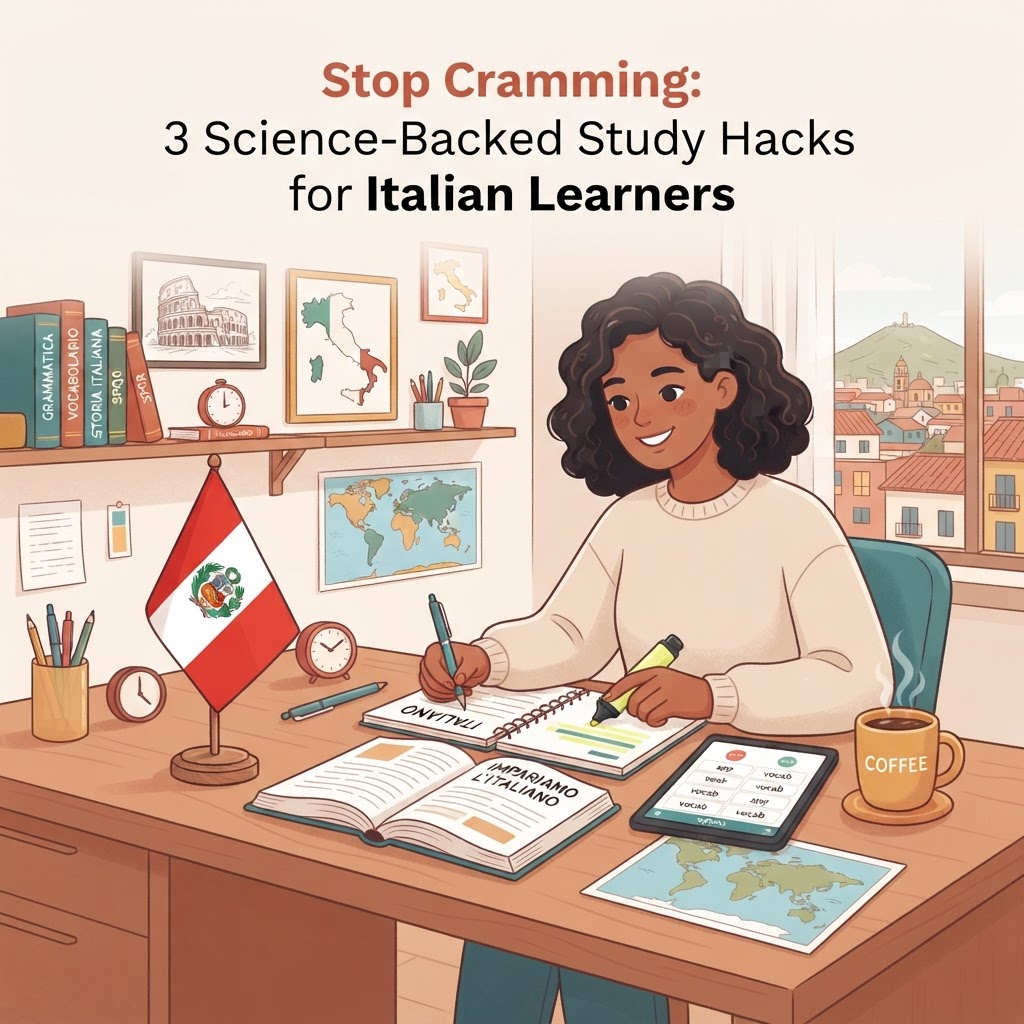
Many adult learners believe that progress is measured by the number of hours spent hunched over a textbook on a Sunday afternoon. However, at Speakup Academy, we often see students who burn out quickly with this approach. The science of learning suggests that your brain actually prefers 'micro-dosing' information. Instead of a two-hour marathon, try breaking your study into 15-minute blocks. This keeps your focus sharp and prevents the cognitive fatigue that leads to frustration.
1. The Power of 'Desirable Difficulties'
It is tempting to reread your notes or highlight textbook passages, but these passive activities often create an illusion of competence. You feel like you understand the material because it is familiar, but you haven't actually encoded it into long-term memory. To truly learn, you must embrace 'desirable difficulties'—tasks that feel slightly uncomfortable but force your brain to work.
Instead of rereading, use active recall. If you are learning Italian verbs, don't just look at the conjugation table. Cover it up and try to write the forms from memory. If you get stuck, that 'struggle' is exactly when the neural connection is being strengthened.
- Example: Instead of reading 'io mangio, tu mangi, lui mangia', try to write a sentence: 'Oggi io mangio una mela' (Today I am eating an apple).
2. Master the 'Input + 1' Rule
Stephen Krashen’s 'i+1' hypothesis suggests that we acquire language best when we engage with content that is just one step above our current level. If you are a beginner, don't jump straight into a complex Italian novel or a fast-paced news broadcast. You will only end up feeling overwhelmed.
Look for 'graded readers' or podcasts designed for learners. The goal is to understand 80-90% of the content through context. When you understand the gist, your brain can naturally infer the meaning of the new 10%—the '+1'—without needing a dictionary for every word. This is why Carmen Solari often recommends specific, level-appropriate resources to our students to bridge the gap between their current ability and their next milestone.
- Example: If you know basic food vocabulary, listen to a simple recipe in Italian rather than a political debate. You might hear: 'Tagliare le verdure a cubetti' (Cut the vegetables into cubes).
3. Contextualize with Mnemonics
Vocabulary lists are notoriously difficult to memorize because they lack 'hooks.' To make words stick, attach them to a vivid image or a personal story. This is the essence of mnemonics. The more absurd or personal the image, the easier it is to retrieve later.
For instance, if you are struggling to remember the word 'scrivania' (desk), imagine yourself 'screaming' at your desk because you have too much work to do. The sound association helps bridge the gap between the English concept and the Italian term.
- Example: 'Il gatto' (the cat) - Imagine a cat wearing a hat. 'Il gatto con il cappello.'
- Example: 'La porta' (the door) - Imagine a 'porter' standing at the door of a hotel.
Why Consistency Beats Intensity
Language learning is a marathon, not a sprint. The 'spacing effect'—reviewing material over several days rather than all at once—is the most effective way to combat the forgetting curve. Even five minutes of reviewing your flashcards while waiting for your coffee is more effective than a single, long, infrequent study session.
At Speakup Academy, we encourage our students to use their live lessons with Carmen as the 'anchor' for their week, using these short, daily habits to keep the language fresh in their minds. By integrating these small, science-backed hacks into your daily routine, you will find that your confidence grows naturally, making your live sessions more productive and enjoyable.
Key Takeaways
- Active Recall: Stop rereading; start testing yourself to force your brain to retrieve information.
- Input + 1: Choose content where you understand the majority of the context to allow for natural acquisition.
- Mnemonics: Use silly, vivid mental images to make new vocabulary 'sticky.'
- Consistency: Short, daily practice sessions are scientifically superior to long, infrequent study marathons.